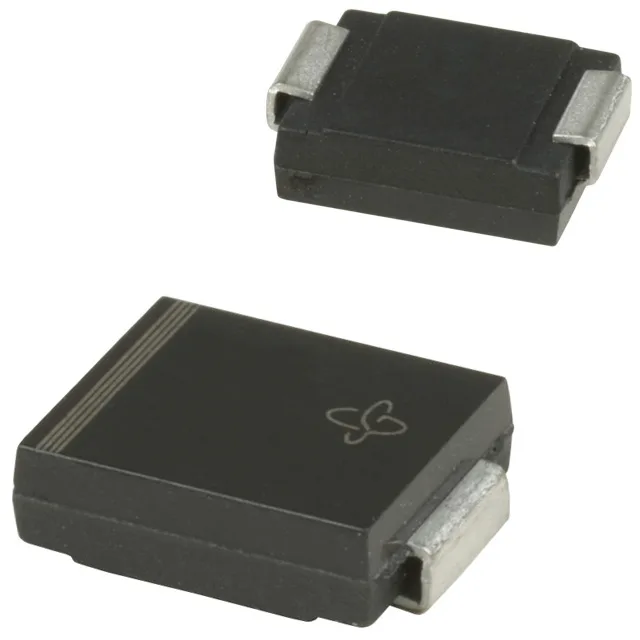
What the 1.5SMC75CA-M3/9AT is and how the CA variant works
The 1.5SMC75CA-M3/9AT is a bidirectional transient voltage suppressor from Vishay's 1.5SMC family — the 'CA' suffix designates the bidirectional polarity variant, which means it clamps both positive and negative transients on the same two terminals without requiring a separate diode in reverse parallel. The family carries the TransZorb trademark, indicating Vishay's internal junction-passivation geometry designed to reduce leakage under sustained reverse-bias stress compared with a plain Zener — relevant for rail-protection applications where the device sits near the operating voltage for extended periods.
Clamping performance: 1500W, 104V, 14.6A — what the numbers mean for protection design
The reverse standoff voltage of 64.1 V defines the working rail the protected circuit runs at without the TVS conducting — above that level the device transitions into avalanche breakdown, and the clamping voltage at the rated 14.6 A peak pulse rises to a maximum of 104 V, giving a protection margin of roughly 40 V above the standoff. That 40 V margin matters for circuits where the protected rail tolerance is tight: a 72 V nominal rail running at its upper operating limit needs the clamping ceiling to stay clear of downstream semiconductor breakdown, and the 14.6 A peak pulse rating means the device handles the surge current without going into thermal runaway on a single-event basis.
The DO-214AB (SMC) package is the dominant SMB-size outline for TVS diodes — the cathode bar in the centre of the package marks the bidirectional polarity orientation, and the two-terminal SMB footprint mates with standard pad patterns on power-supply and protection board layouts without requiring a non-standard land pattern. Surface-mount Tape & Reel packaging suits automated placement in high-volume assembly; no through-hole leads means the rework profile uses a hot-air or IR reflow tool rather than a soldering iron, which is faster for panel rework on assembled boards.