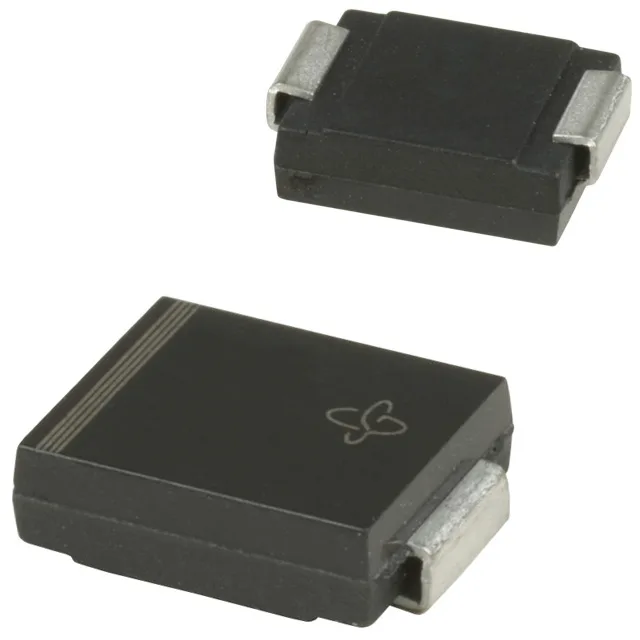
What the clamping specs mean for your rail
The 1.5SMC75AHM3/I: The reverse standoff of 64.1 V nominal means the line sits comfortably below the clamping threshold during normal operation, so the TVS only fires on transients. For a 48 V automotive rail (a common telecom and vehicle bus), the 64.1 V standoff gives roughly 16% headroom above the 54 V peak of a fully-charged battery — enough margin before the Zener avalanche kicks in at the 71.3 V minimum breakdown point. This is a clamp-and-dump device: it avalanche-brefs at the Zener voltage and then returns to standby once the event clears. The 1.5 kW rating is the 10/1000 µs surge window, and the part is rated for that event multiple times in its working life without degradation — the exact number of repeatable strikes is in the Vishay datasheet derating curves.
This part carries the AEC-Q101 qualification — the automotive discrete semiconductor stress screen covering temperature cycling, humidity, and surge exposure. For automotive ECUs under the hood, the 150 °C maximum junction temperature matters: you can run the part near thermal limits in engine-bay enclosures without immediately derating below the clamping threshold, as long as the board-level thermal path keeps the SMC tab below its rated limit.
Where the 1.5SMC series sits
The 1.5SMC series covers standoff voltages from roughly 6.8 V up to 200 V in the same SMC package — this specific variant at 64.1 V standoff sits in the mid-range, common on 24 V and 48 V industrial and automotive power rails. The unidirectional channel count of one means it protects a single polarity rail — if you need bidirectional protection across a floating AC-coupled node, look at the bidirectional variant in the same series, which carries the same clamping and peak pulse ratings.