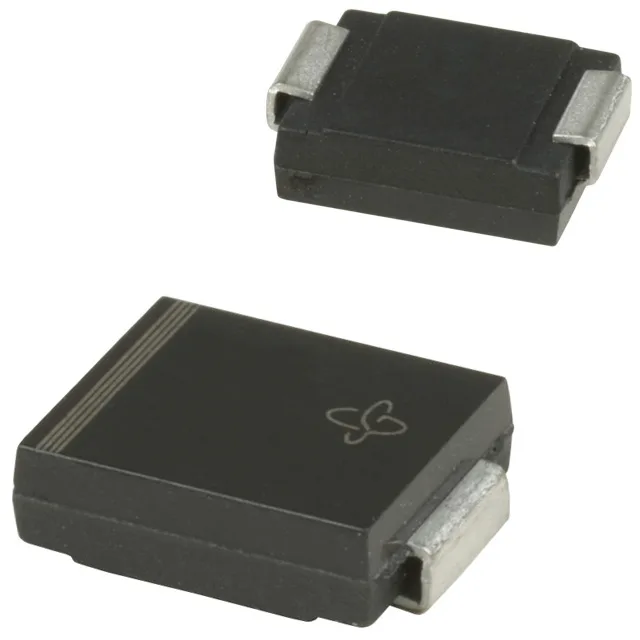
Vishay General Semiconductor - Diodes Division 1.5SMC75AHE3/57T — Circuit Protection

1.5SMC75AHE3/57T TVS Diode, 1500W Peak Pulse, AEC-Q101

MPN1.5SMC75AHE3/57T
Active

Vishay General Semiconductor Zener TVS, Automotive AEC-Q101, 1.5SMC series, unidirectional, 1500 W peak pulse, 64.1 V standoff, 104 V clamping, DO-214AB (SMC) surface mount.

Independent supplier — new & surplus stockAuthenticity-screened · ESD-safe packingListing updated Aug 2026

Specifications

1.5SMC75AHE3/57T specifications
ParameterValue
TypeZener
SeriesAutomotive, AEC-Q101, 1.5SMC, TransZorb®
MountingSurface Mount
Voltage - breakdown71.3V
Voltage - clamping (Max) @ ipp104V
Voltage - reverse standoff64.1V
Current - peak pulse (10/1000μs)14.6A
Power - peak pulse1500W (1.5kW)
Power line protectionNo
Operating temperature-65°C~150°C(TJ)
PackageTape & Reel (TR)
ApplicationsAutomotive
CaseDO-214AB, SMC
Unidirectional channels1

Product details

Clamping parametrics and the 48V automotive rail

The 1.5SMC75AHE3/57T: The 64.1 V standoff rating defines the continuous working voltage the TVS sees in normal operation — it sits across the rail unclamped. A transient that exceeds 71.3 V triggers the Zener breakdown, and the clamping network limits the peak at 104 V with 14.6 A of 10/1000 µs surge current flowing through it. For a 48V automotive board rail this gives comfortable margin — the standoff sits above the nominal 48V battery float and the clamping ceiling clears the transients defined in ISO 7637-2.

AEC-Q101 qualification for under-hood deployment

The maximum operating TJ of 150°C means the part carries thermal headroom above an engine-bay ambient that might reach 125°C at the ECU — the delta is narrow and the PCB thermal design has to keep the Zener's internal dissipation below what raises TJ past that limit. The qualification covers the surge repetition and temperature cycling stress tests that a raw commercial TVS would not have passed.

Frequently asked questions

What voltage does the 1.5SMC75AHE3/57T clamp at, and what surge can it take?

It breaks down at a minimum of 71.3 V and clamps at a maximum of 104 V when the 10/1000 µs peak pulse current of 14.6 A is flowing. The peak pulse power rating is 1500 W (1.5 kW) for that same waveform — the part is sized for the surge event, not for continuous dissipation.