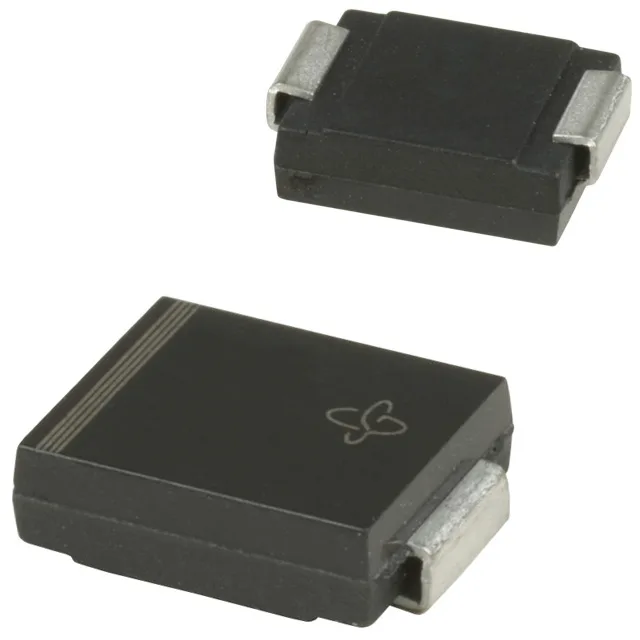
Active part — what the 1500W peak-pulse rating actually means
The 1.5SMC75A-E3/9AT: The 1500W peak pulse rating is measured under the IEC 61000-4-5 double-exponential surge waveform (10/1000µs), which is the standard transient-suppression test for protection circuits on power and signal lines. At 14.6A peak pulse current the device clamps at 104V maximum — that 104V is the ceiling the downstream load sees when a surge event occurs, so the downstream rail's working voltage must stay comfortably below that clamp ceiling.
Standoff, breakdown, clamp — the TVS selection window for a 75V rail
The reverse standoff voltage is 64.1V typical — the TVS sits idle on the rail below this and draws only leakage current, meaning a 48V or 60V nominal bus runs cleanly without the TVS activating. When a transient pushes the rail above 71.3V the device enters breakdown and begins clamping — that 71.3V minimum breakover is the activation threshold, so it protects rails up to roughly 68V nominal with margin. The 104V clamping ceiling at full surge current is the figure the downstream IC or connector must withstand — if the load side is rated below 104V working voltage, a secondary clamping stage or MOV may be needed upstream.
TransZorb versus a standard Zener — this is not a regulator
The 1.5SMC series is a Vishay TransZorb® family — these are transient voltage suppressors, not voltage regulators Zeners. The peak-pulse power and clamping behaviour are the primary selection criteria, not the nominal Zener voltage alone. Unidirectional polarity — it protects one polarity only, so for AC rails or bipolar signal lines a back-to-back pair or a bidirectional TVS variant is required. Operating junction temperature runs to 150°C, which gives headroom for deployment in enclosed panels or near thermal sources without derating the clamping performance below the datasheet limits.
SMC package — assembly and footprint note
DO-214AB (SMC) is the standard JEDEC surface-mount footprint — the cathode band marks the polarity stripe on the body. Solder reflow profile must comply with the moisture-sensitivity level for this package; check the Vishay IPC/JEDEC J-STD-020 classification before bake. Supplied on tape and reel — the reel quantity and orientation match standard SMC pick-and-place tooling, but confirm with your CM that the feeder width suits the specific reel pitch.