Clamp performance — what the surge ceiling means
The 1.5SMC7.5CAHM3/H: A 5 V rail clamped at 11.3 V during a transient spike is survivable for most downstream ICs, but confirm the downstream absolute-max input before committing the BOM line. With 7.13 V minimum breakdown, the standoff band of 6.4 V typical gives adequate headroom above a 5 V nominal rail — the TVS stays invisible across the rail during normal operation and turns on only when the transient exceeds the standoff threshold.
AEC-Q101 grade and thermal margin
Automotive AEC-Q101 qualification means this part passed the temperature-cycle, surge-life, and humidityBias stress sequence defined in AEC-Q101 Rev-D — it is cleared for under-hood and chassis-adjacent power-protection positions where the -65 °C to 150 °C TJ range matters. TransZorb® construction gives bidirectional clamping — this is a single-directional channel per the spec table, so it protects one polarity of fault. Verify the fault direction matches the rail polarity before specifying.
DO-214AB SMC footprint — what it connects to
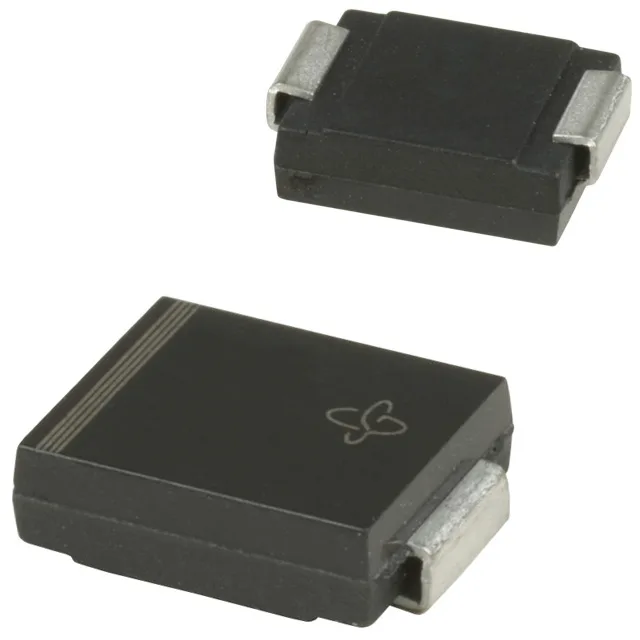
Surface-mount DO-214AB (SMC) is the standard landing for 1500 W unidirectional TVS arrays in automotive ECUs and telecom power supplies — the cathode bar on the package aligns with the protected rail net, and the thermal pad under the body handles the surge dissipation. Verify the PCB pad geometry against the Vishay SMC footprint drawing before releasing to layout.