What the clamping hierarchy means for your protection circuit
The 1.5SMC7.5CAHE3/57T is a bidirectional TransZorb TVS designed to clamp voltage transients on automotive supply rails. The three-voltage clamping hierarchy is what drives the selection decision: 6.4 V reverse standoff is the maximum operating voltage the diode leaks negligibly across; 7.13 V minimum breakdown is where it begins conducting; and 11.3 V is the maximum clamping voltage at the rated peak pulse current of 133 A. That 11.3 V ceiling is the figure that determines whether downstream ICs survive a defined surge event — the diode absorbs the transient and clamps the bus to this level. 1500 W peak pulse power rated at 10/1000 µs waveform means the device handles the slower, higher-energy transients typical of automotive load-dump and inductive kickback — not the ultra-fast ESD events that a dedicated ESD protection diode handles better. If your protection target is an ECU supply rail or CAN bus node, this is the part class you reach for.
Why the automotive grade matters for under-hood deployment
A commercial-grade SMC TVS without this rating has no documented margin for that envelope. For a 12 V automotive supply rail that can see load-dump transients up to 40 V before clamping, the standoff-to-breakdown spacing on this 6.4/7.13 V part is not a mismatch — the transient is higher, but the clamping event is brief enough that the diode absorbs it within its peak pulse rating.
DO-214AB SMC package and automotive assembly
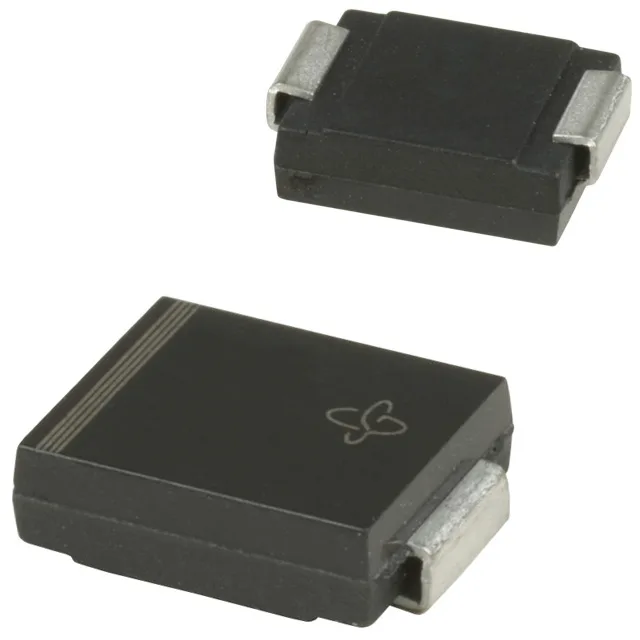
The DO-214AB (SMC) package is the standard surface-mount outline for automotive power TVS diodes — the cathode bar on the top of the package identifies the polarity direction on the unidirectional variant, but the CA suffix confirms this part is bidirectional. Tape-and-reel packaging is standard for high-volume automotive assembly pick-and-place lines. The supplier device package is listed as SMCJ, which refers to the industry standard outline — the body dimensions are identical to DO-214AB, so land pattern and solder joint inspection criteria follow the JEDEC SMCJ footprint.