What the clamping specs mean for your rail
The 1.5SMC7.5AHM3_A/I is a unidirectional Zener-type TVS (TransZorb®) — it clamps during overvoltage events by turning on at the breakdown threshold, not by blocking a fixed rail. The 6.4 V reverse standoff is the normal working voltage the protected rail can sit at continuously without the TVS conducting; above 7.13 V min breakdown the device enters avalanche and holds the clamped voltage. Selecting a TVS for a 5 V rail means the downstream circuit must survive 11.3 V for the duration of the event, which is typically within the absolute-maximum rating of most logic-level devices but demands verification for sensitive analog rails. Repeated transients at the full 1500 W will push the junction toward the 150 °C maximum; the TVS does not regulate like an LDO and is not sized for continuous current conduction.
AEC-Q101 qualification and automotive deployment
AEC-Q101 qualification means the part passed the automotive stress suite — including high-temperature reverse-bias, temperature cycling, and pulsed operation — at the graded temperature extremes. Automotive and telecom are the named application spaces; both involve long cable runs exposed to inductive kick and ESD from load switching. A telecom base-station power input sees the same surge waveform (10/1000 µs) as an automotive ECU supply line — the 133 A peak pulse current rating tells you the device survives a direct lightning or load-dump surge without going short-circuit, which would blow the upstream fuse and take the rail down.
Sourcing posture and active status
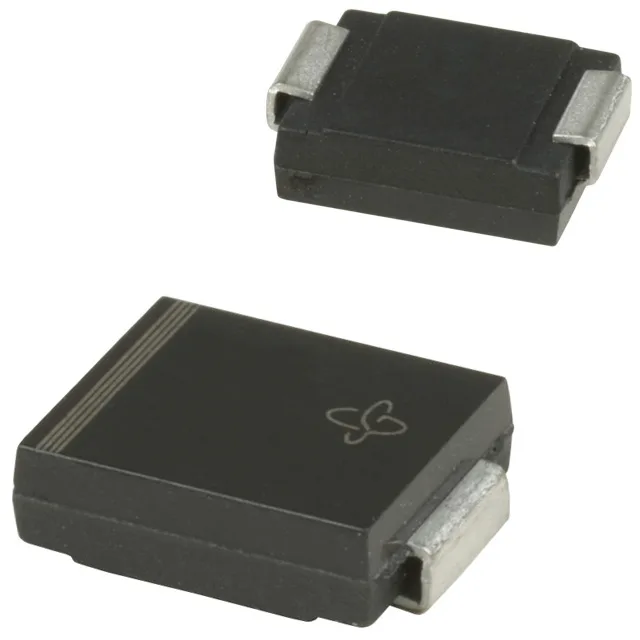
The part is listed Active by Vishay General Semiconductor — it carries a base product number of 1.5SMC7.5, which structures the rest of the 1.5SMC family so you can cross-reference to adjacent standoff voltages on the same footprint without a board spin. The Tape & Reel packaging matches standard SMT feeder setup on high-volume assembly lines.