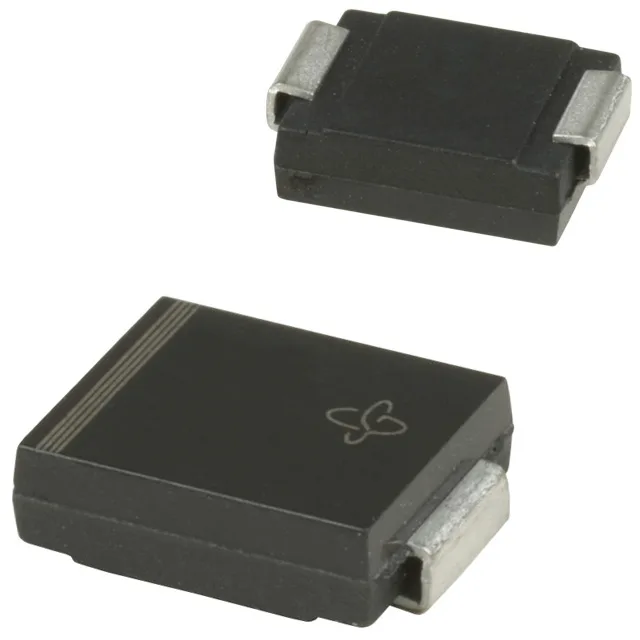
What the 1.5SMC68CAHM3_A/H is and where it fits
The CA suffix confirms the bidirectional polarity and the H suffix flags the Automotive, AEC-Q101 qualified grade.
Voltage ratings and surge survivability
The reverse standoff voltage is 58.1 V typical — above this the TVS begins to respond but has not yet clamped. Breakdown occurs at a minimum of 64.6 V, and the clamping ceiling is 92 V maximum at the rated peak pulse current of 16.3 A. The clamping voltage of 92 V is what reaches the downstream circuit if the transient exceeds the standoff, so the protected rail must tolerate a brief excursion to that level. The cold end covers engine-bay cold-start and high-altitude conditions; the 150 °C upper limit is set by the die and the TransZorb® junction structure, giving margin against thermal runaway on slow, high-energy transients where the clamping action dumps sustained power into the device.
AEC-Q101 qualification — what it means for the BOM
The series designation Automotive, AEC-Q101 confirms this part passed the automotive discrete semiconductor qualification stress battery — humidity, temperature cycling, surge life, and ESD human-body model — at a level suitable for deployment in ECUs, BCMs, and powertrain control modules. The H suffix (AEC-Q101 H-grade) is the higher-stress screening tier within the AEC-Q101 family, which is what OEM auditors and Tier-1 PPAP reviewers look for when a part is specified in an automotive safety or mission-critical circuit. In automotive, the 58.1 V standoff sits above the 12 V nominal rail with sufficient margin for load-dump transients, which can spike 40–60 V above battery return. In telecom, the same standoff voltage covers 48 V bus overvoltage events on control and signal pairs. The bidirectional configuration is the right choice when the protected node swings both above and below reference — a half-bridge node, an AC-coupled data line, or a bipolar supply rail.
Lifecycle and sourcing posture
The part carries an Active lifecycle status per the manufacturer record.