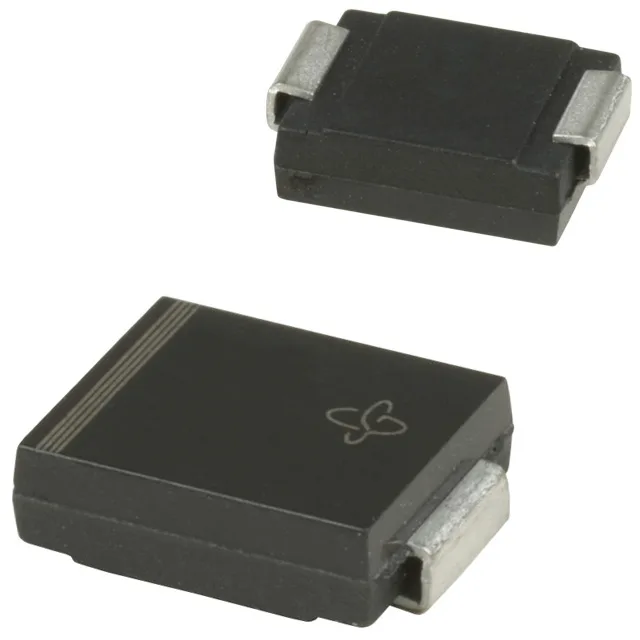
What the 1.5SMC68CAHE3_A/I is and where it fits
This is a unidirectional Zener-based TVS (Transient Voltage Suppressor) from Vishay's 1.5SMC series — the TransZorb® family — qualified to AEC-Q101 for automotive environments. The 'C' in the order code marks it as bidirectional, and the 'HE3' suffix designates the automotive grade and the Tape & Reel packaging variant. The standoff voltage of 58.1 V typ means the diode sits idle on the line during normal operation, presenting a high-impedance leak path. When a surge drives the line above the breakdown threshold of 64.6 V min, the device clamps and conducts the fault current away from the downstream circuitry.
Clamping ceiling and peak pulse power
Rated 1500 W peak pulse power, which is the headroom that determines how large a surge the part absorbs before it fails — a 10/1000 µs surge within the rated energy envelope does not degrade the clamping characteristic.
Automotive temperature grade and AEC-Q101
An ECU in a engine bay that sees 130 °C on a summer day still has thermal margin — the part does not derate until the junction approaches 150 °C. AEC-Q101 qualification means the part passed the automotive stress tests: humidity, temperature cycling, and surge lifetime — the kind of screening a commercial-grade TVS diode skips. For automotive designs the qualification is not optional; it is the gate to the Bill of Materials.
Sourcing — active production and independent distribution
The 1.5SMC series is a long-running platform in the standard DO-214AB SMC package, which means the same footprint is shared across many second-source TVS suppliers — a useful hedge for single-source exposure in a BOM. Available to order against BOM requirements through independent distribution channels. Confirm current lead times and pricing at RFQ — availability is quoted to order, not guaranteed from stock.