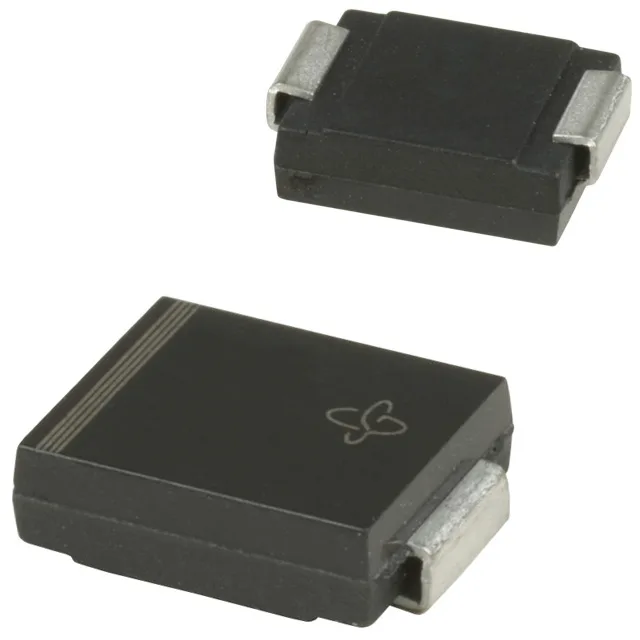
What the 1.5SMC68CA is — and why the CA matters
The 1.5SMC68CA-E3/9AT: The 1.5SMC68CA is a unidirectional TVS Zener from Vishay's 1.5SMC series, marketed as a TransZorb® — Vishay's trade name for the Zener-based transient voltage suppressor structure. The CA suffix tells you it is bidirectional, which means it clips both polarities of a transient spike to the same clamping level, making it the right choice for AC rails, automotive polarity-reversal events, and any node that sees both positive and negative excursions. If you picked up a bare 1.5SMC68 part without checking the suffix you may have bought a unidirectional — the CA is not optional for symmetric bidirectional protection.
The clamping chain — what each voltage rating decides
The standoff voltage of 58.1 V sets the DC working rating — the TVS idles below its breakdown as long as the rail stays under 58.1 V, drawing only its reverse leakage current. For a 48 V nominal rail this gives roughly 21% headroom under normal operation, which is the usual target for industrial power buses — tight enough to protect downstream ICs, wide enough to avoid false triggering from supply ripple. Sustained overvoltage above the standoff will destroy it, so the 58.1 V working rating is the hard ceiling for continuous operation, not a target. If your rail sags and recovers quickly the device handles it; if it hangs above 58.1 V for milliseconds the clamping circuit goes into thermal runaway. The 150 °C maximum junction temperature gives good headroom for automotive and industrial environments that run junction elevated above ambient — a sealed enclosure at 85 °C ambient with a clamping event that raises the junction 30–40 °C still has margin before hitting the limit. The -65 °C low end covers cold-start and outdoor deployments.
Package and field-replaceability notes
The DO-214AB (SMC) package is the mid-size SMC variant — larger than the SMA (DO-214AC) and smaller than the SMB (DO-214AA), with a footprint that takes a standard hand-solder tip. The cathode band on the SMC body marks polarity on the unidirectional variant, but the CA bidirectional device has no stripe — orientation is usually confirmed by the part orientation on the reel or by checking the base product number printed on the body. For field replacement, a hot-air tweezer set to 245 °C reflows the solder joint without disturbing adjacent components on a typical two-sided layout, provided the board has been properly baked if moisture sensitivity is a concern. Tape-and-reel packaging is standard for automated placement — if you are hand-placing from a cut-tape strip, orient the reel label toward you and feed the tape from left to right. The 1.5SMC68CA is general-purpose rated and carries no explicit power-line protection flag, so it is not the right part for dedicated 120/240 V mains surge suppression — look at the 1.5SMCxxCA-H series if you need the 1.5 kVA (1500 V) line-frequency hold-off rating for direct mains connection.
The 1.5SMC68CA carries an Active lifecycle flag with no NRND notice and no published end-of-life date in the current record — the 1.5SMC series is a long-running Vishay general-purpose family and the CA variant at 68 V standoff sits in a common voltage bucket for 24 V and 48 V industrial rails, so it is unlikely to go NRND soon. That said, the 1.5SMC series is large and not every voltage is equally stocked — confirm lead time and MOQ at RFQ for any order above reel quantities. The base product number 1.5SMC68 means it drops into the same tape-and-reel format as the full series, so reel quantities are interchangeable within the family if you need a voltage step.