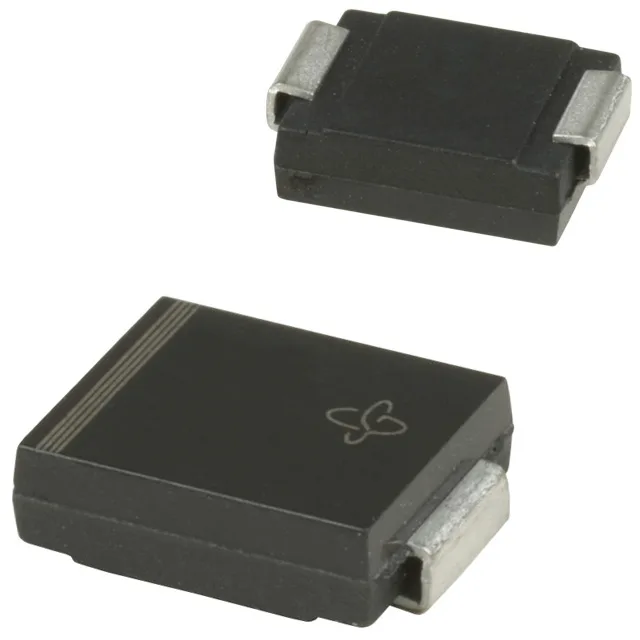
68V bidirectional TVS in SMC package
The 1.5SMC68CA-E3/57T: The 1.5SMC68CA is a unidirectional TransZorb® TVS diode — the CA suffix designates the bidirectional polarity configuration. Rated 58.1V reverse standoff (typ), 64.6V minimum breakdown, and 92V maximum clamping at the 16.3A peak pulse current — the clamping voltage is the figure that matters for downstream IC protection margins, since it sets the maximum voltage the protected circuit sees during a transient event.
Wide junction temperature range — general-purpose deployment
Operating junction temperature runs −65°C to 150°C — that span covers the full industrial envelope from cold-storage environments to enclosed equipment without active cooling. The diode is general-purpose rated, meaning it is not screened to an automotive AEC-Q101 or defence JAN flow; it belongs in commercial and industrial control boards, power supplies, and communication equipment where the clamping margin is the primary design check, not a qualified life-test program.
Surface-mount SMC body and tape/reel packaging
DO-214AB (SMCJ) supplier package, surface-mounted — the wide metal tab under the body is the thermal and electrical common node, so the PCB pad design must respect the single-terminal form factor and provide adequate copper area for the transient energy dissipation. Shipped in tape-and-reel (TR) and cut-tape (CT) — the reel format suits high-volume pick-and-place; cut tape is common for prototyping runs. One bidirectional channel, power-line protection is not listed as a primary application — this is a point-of-load clamping device, not a bus protector.
Active lifecycle — supply posture
The base product number 1.5SMC68 places it in a long-running series with multiple voltage variants in the same body, so a second-source match within the family is worth checking at RFQ if single-source risk is a concern.