Clamping mechanics and surge rating
The 1.5SMC68AHM3_A/I: The 58.1V reverse standoff is the working voltage — the diode presents a high impedance below this, so the protected rail runs normally. At 64.6V minimum breakdown it begins conducting, and the 10/1000µs surge test waveform (the standard automotive and telecom surge event) pushes it to a 92V clamping ceiling at 16.3A peak. That 1500W peak pulse rating is the 10/1000µs figure — the same test wave used in ITU-T K.44 surge immunity testing for telecom power and ISO 7637-2 for automotive conducted transients, so the 1.5SMC family slots directly into those qualification test plans.
AEC-Q101 automotive grade and thermal margin
The AEC-Q101 qualification screens this part for the stress sequence used on automotive electronics programs — temperature humidity bias, high-temperature reverse bias, and temperature cycling per AEC-Q101. The junction temperature range is -65 to 150°C — the upper bound matters for under-hood and transmission-control deployments where ambient can approach 125°C and the diode self-heats from clamping events. Confirm the PPAP package and the AEC-Q101 lot traceability requirements with your component engineer before committing to a new automotive program; the H-suffix on the order code designates the automotive grade within the 1.5SMC series.
SMC (DO-214AB) footprint and assembly
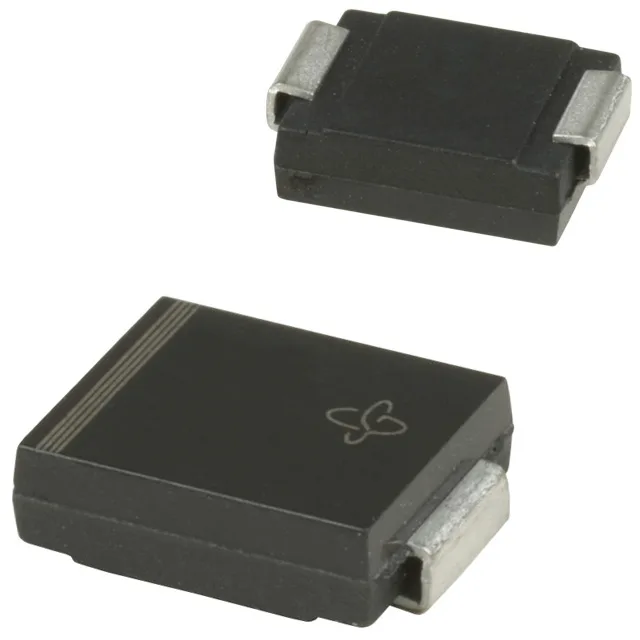
The DO-214AB (SMC) package is the medium-crown variant — larger anode and cathode pads than the DO-214AA (SMA) but the same footprint pitch, which means the land pattern and solder-mask-defined pad geometry are identical across those two grades. Supplied on tape-and-reel; the cathode band on the package body marks the unidirectional polarity, and the stripe must orient correctly on the PCB before reflow — there is no polarity reversal tolerance on a unidirectional TVS.
Vishay lists this as Active. Confirm lot date code and AEC-Q101 conformance documentation requirements before placing the order, particularly for automotive or telecom infrastructure programs that require PPAP or IEC 62368-1 compliance evidence.