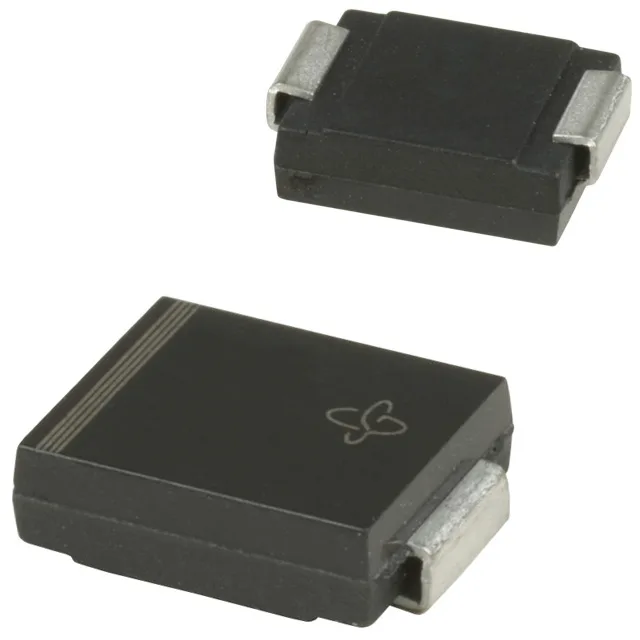
Transient protection rating and what the clamping spec means
The 1.5SMC68AHE3/9AT: That 92 V ceiling is the protected rail voltage under a IEC 61000-4-2 or similar surge event — the downstream circuitry sees no more than 92 V regardless of the incoming transient amplitude. The 1.5 kW peak pulse rating (1.5SMC —) defines the device's energy absorption ceiling for a 10/1000 µs waveforms — this series is sized for board-level signal and control line protection, not power bus clamping. The unidirectional single-channel topology means it handles one polarity of transient only; bidirectional protection requires two devices or the complementary polarity series. Power line protection is listed No — this is a signal/control-line TVS, not a primary power bus clamp.
Automotive qualification and temperature grade
AEC-Q101 qualification means the die and package passed the automotive stress sequence — humidity, temperature cycling, surge current, and mechanical shock — at the wafer level. The DO-214AB SMC package mounts flat to the PCB with solder-terminated leads — the cathode tab under the body is the primary heatsinking surface. The package is not isolated from the lead frame, so electrical isolation from a heatsink requires a separate dielectric pad or mica washer in thermally stressed layouts.
Automotive TVS selection — where the 1.5SMC family fits
The 1.5SMC series is the automotive screened sister to the standard 1.5SMC line — the base number 1.5SMC68 confirms the 68 V nominal standoff band, which targets 48 V automotive board nets and ECUs operating near that rail. TransZorb® is Vishay's trademark for the bidirectional TVS construction: the unidirectional variant used here is the correct orientation for protecting a rail referenced to chassis ground.