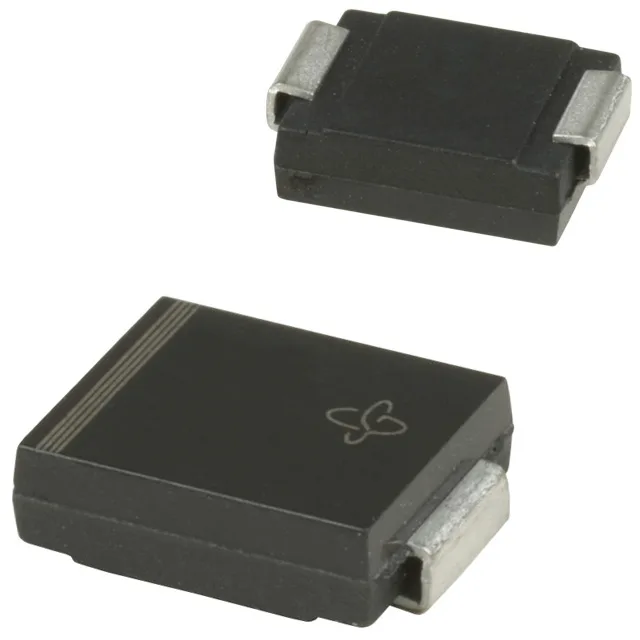
Transient suppression profile for automotive rails
The 1.5SMC62CAHE3/9AT: 53 V typical reverse standoff means the TVS idles below breakdown on a 48 V nominal rail, only clamping when a transient pushes the node above that threshold. The 58.9 V minimum breakdown is the floor — the device guarantees it triggers no higher than that on a worst-case fast-rising edge. The datasheet's Vc versus Ipp curve is what determines survivable event profiles for your specific load.
AEC-Q101 automotive qualification and thermal margin
The AEC-Q101 designation is the automotive-grade stress qualification — it certifies the part passed temperature cycling, humidity bias, and surge testing to a standard that covers chassis and powertrain environments, not just cabin-level thermal conditions. Thermal design of the board pad and trace copper under the cathode tab determines how many pulses the part survives at rated peak current. Single bidirectional channel — this is the unidirectional-only protection topology; if AC-line polarity reversal is a real fault mode, a unidirectional TVS does not cover it. For a DC rail like automotive battery, the bidirectional variant simply mirrors the clamping characteristic in both polarities, which is redundant unless the protected node sees negative transients from inductive kick during a fault.
Sourcing posture — active production
Active lifecycle — Vishay General Semiconductor — Diodes Division continues this part under the 1.5SMC series with no listed successor. For a new automotive design, qualify the alternate from the same 1.5SMC family now — do not wait for a last-time-buy notice.