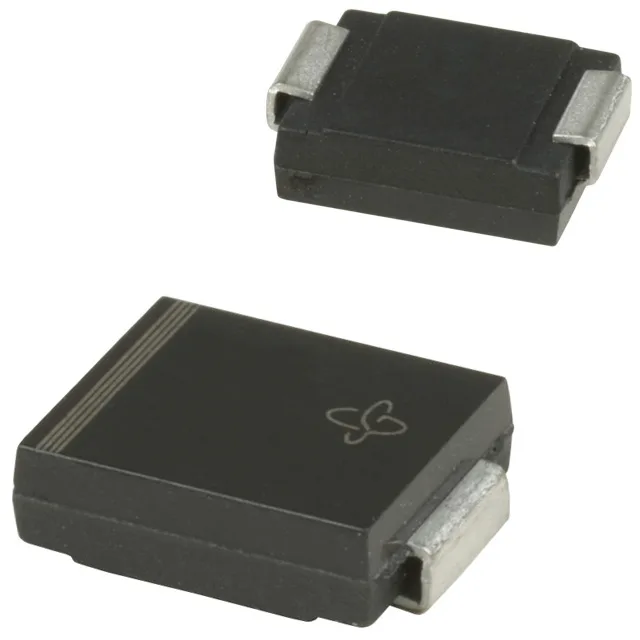
DO-214AB SMC footprint and board integration
The 1.5SMC62AHM3/H: Because the junction operates up to 150°CTJ, the board-level thermal path through the cathode pad determines the clamping performance under sustained transients, not just the peak-pulse rating alone.
What the clamping ratings mean for protection decisions
Reverse standoff of 53 V defines the normal operating rail the TVS watches without conducting — transients that exceed this level cause the Zener junction to avalanche. Minimum breakdown of 58.9 V sets the guaranteed turn-on threshold; the clamping voltage ceiling of 85 V at the rated peak pulse current of 17.6 A is the let-through voltage the protected load actually sees during a 10/1000 µs surge event. Selecting for a higher peak current demands verifying the surge waveform matches the test condition on the datasheet curve.
Automotive qualification and temperature grade
The AEC-Q101 stress qualification is the relevant gate for automotive ECU designs — it certifies the part has passed humidity, temperature cycling, and surge life testing at the device level rather than the generic JEDEC JESD22 suite. Junction temperature is rated to 150°C, which provides margin in engine-compartment or exhaust-adjacent locations where the board-level ambient routinely reaches 125°C. Unidirectional polarity means this part clamps only positive transients relative to ground — for bidirectional protection or AC supply rails a dual-polarity TVS is required; this part is explicitly listed as a single unidirectional channel.