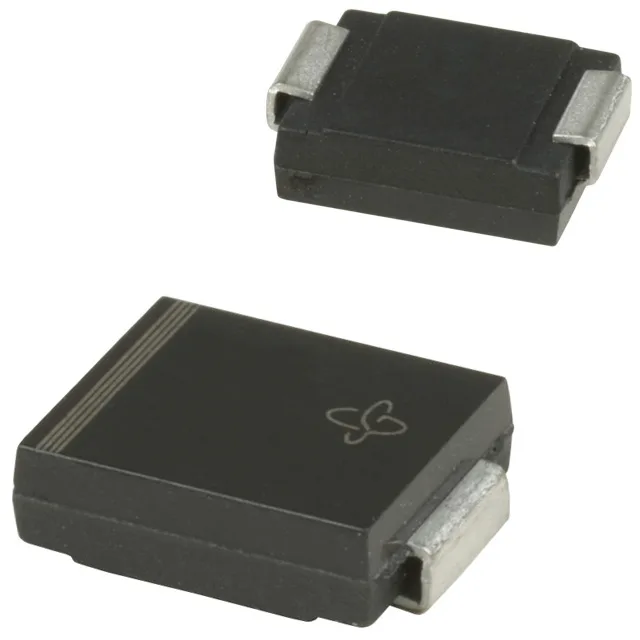
What the 1.5SMC62A actually is
The 1.5SMC62A-M3/9AT: This is a unidirectional TVS diode from Vishay's 1.5SMC series, built on the TransZorb® platform — the trade name for Vishay's original asymmetric junction transient voltage suppressor architecture. The "62" in the base part number (1.5SMC62) denotes the 62 V breakdown region, and the "A" suffix locks in the unidirectional polarity and the specific clamping band. Unidirectional means it clamps positive transients in one direction only — the cathode band on the DO-214AB body marks the polarity. For bidirectional protection or AC lines you need the B-suffix variant. If the circuit sees both polarities, the 1.5SMC62A is the wrong part regardless of the voltage match. The DO-214AB (SMC) package is the mid-size SMC outline — larger than the SMA (DO-214AC) and smaller than the SMB. The cathode band is the orientation marker, readable under a microscope or loupe on a populated board. Pin 1 is the cathode; the anode is the opposite lead.
Clamping action and what the voltage ratings mean
53 V is the reverse standoff — the maximum voltage the TVS sees in normal operation without conduction. The 58.9 V minimum breakdown is where the junction begins conducting. At 17.6 A peak pulse (10/1000 µs waveform), the clamping voltage rises to 85 V maximum — that is the voltage the protected node sees during the transient event. 1.5 kW peak pulse rating (1.5SMC) is a 1 ms rectangular pulse equivalent — the series is sized for board-level transient events, not continuous power dissipation. A sustained overvoltage does not behave like the peak pulse spec: the part will heat and fail if the clamping duration exceeds the thermal time constant of the package and board pad. For a 24 V rail protection, the 53 V standoff gives a 2.2× margin above the working voltage — adequate for EN 61000-4-2 ESD and for many inductive kick transient profiles. For a 48 V rail the margin drops to 1.1×, and a standoff-margin-deficient TVS will idle-leakage conduct at normal voltage, so verify the nominal rail is well below 53 V before specifying.
Thermal profile and junction temperature
A 4-layer board with thermal vias under the cathode pad extends the effective thermal path — the datasheet curve is what to check if the part is on a high-temperature ambient board or in an enclosed box. The -65°C low end covers cold-start and outdoor enclosures in winter; it is not usually a constraint but matters for aerospace and transportation where the board can see deep cold between power cycles. The TJ suffix in the spec confirms the rating is junction temperature, not ambient.
Sourcing and production status
The part is listed Active by Vishay General Semiconductor — the 1.5SMC series has a long production runway and is not under any announced discontinuation. Surface-mount in Tape & Reel packaging — standard quantity per reel is defined by the manufacturer's reel count, confirm the strip length and hub size for high-volume assembly lines where reel-empty stops on the pick-and-place matter for line utilization calculations.