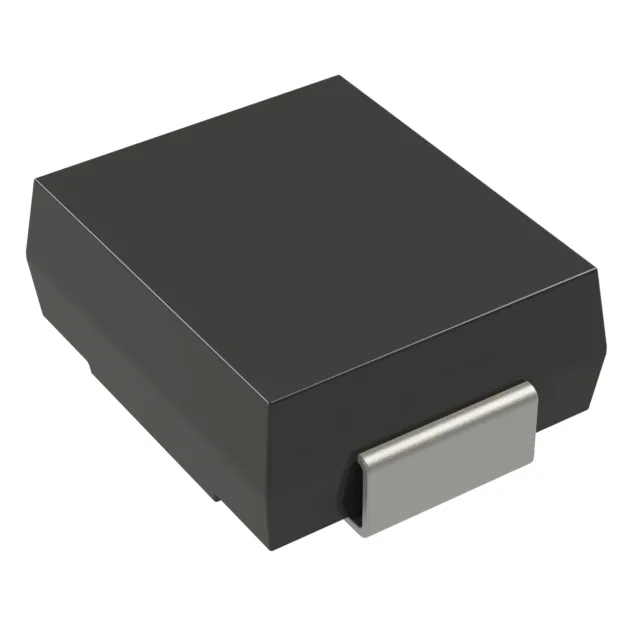
Device identity and board integration
The 1.5SMC6.8CAHM3/I is a bidirectional Zener-based TVS (Transient Voltage Suppressor) — Vishay calls this construction TransZorb® — qualified to AEC-Q101 for automotive deployment. The "C" in the part number confirms bidirectional polarity, which is the key selection point: a unidirectional TVS clips only positive transients relative to ground, whereas the bidirectional variant clamps both positive and negative swings. On a differential signal line or a bus that sees bipolar noise, that distinction is the entire fit decision. The DO-214AB (SMC) package is the standard 2-pin Gull Wing surface-mount outline — the cathode bar on the body markings identifies the polarity direction. Thermal resistance from junction to lead is governed by the PCB pad area under the termination pads; Vishay specifies the mounting pad geometry in the product datasheet, and the 150°C maximum junction temperature (TJ) constrains the pad design. The Tape & Reel packaging is the normal reeled quantity for automatic placement on automotive SMT lines.
What the clamping ratings mean for the protection circuit
The reverse standoff voltage of 5.8 V typ is the working voltage the line sees in normal operation — the TVS presents a high impedance and conducts only leakage current. When a transient drives the line above the breakdown threshold, the device turns on. The minimum breakdown is 6.45 V, so the TVS stays off below that. At the clamped voltage of 10.5 V max under the peak pulse condition of 10/1000 µs waveform (the standard telecom and automotive surge test shape), the peak pulse current reaches 143 A. That 143 A figure is the design anchor for the upstream series resistance and the PCB trace width feeding the TVS — if the clamping voltage times the peak current exceeds the energy capability of the package, the TVS fails short, which is the intended behavior for a protection device. Telecom applications (listed as an application on this part,) commonly face 10/700 µs and 8/20 µs surge shapes — the 10/1000 µs figure is conservative for the longer-tail waveform; a shorter, higher-current surge at the same energy will produce a higher clamping voltage, so check the V-I curve in the datasheet against the specific surge standard your system must pass (IEC 61000-4-5, GR-1089, or an OEM-specific automotive pulse).
Automotive grade and sourcing posture
AEC-Q101 qualification means this part has passed the automotive stress suite: environmental cycling, high-temperature reverse bias, surge life, and mechanical shock/vibration — the test sequence that qualifies discrete semiconductors for engine-compartment and chassis-domain deployment. The base product number 1.5SMC6.8 anchors the family; the full suffix CAHM3/I encodes the automotive grade, package variant, and screening level.