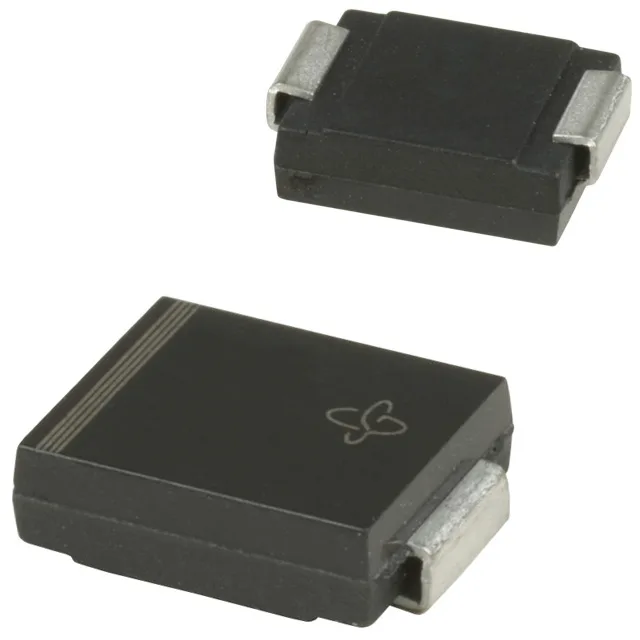
Vishay General Semiconductor - Diodes Division 1.5SMC6.8CAHE3/57T — Circuit Protection

1.5SMC6.8CAHE3/57T TVS Diode, 1500W, Bidirectional, AEC-Q101

MPN1.5SMC6.8CAHE3/57T
Active

Vishay General Semiconductor, Automotive AEC-Q101, 1.5SMC TransZorb, 1.5SMC6.8CAHE3/57T, bidirectional TVS diode, 1500W peak pulse, 6.45V min breakdown, 10.5V clamping, DO-214AB SMC, surface mount, Tape & Reel.

Independent supplier — new & surplus stockAuthenticity-screened · ESD-safe packingListing updated Aug 2026

Specifications

1.5SMC6.8CAHE3/57T specifications
ParameterValue
TypeZener
SeriesAutomotive, AEC-Q101, 1.5SMC, TransZorb®
MountingSurface Mount
Voltage - breakdown6.45V
Voltage - clamping (Max) @ ipp10.5V
Voltage - reverse standoff5.8V
Current - peak pulse (10/1000μs)143A
Power - peak pulse1500W (1.5kW)
Power line protectionNo
Operating temperature-65°C~150°C(TJ)
PackageTape & Reel (TR)
ApplicationsAutomotive
CaseDO-214AB, SMC
Bidirectional channels1

Product details

1500W peak pulse — what the clamping spec means

The 1.5SMC6.8CAHE3/57T is a bidirectional TVS (Transient Voltage Suppressor) diode, also called a TransZorb, rated 1500W at the 10/1000 µs peak pulse waveform. In automotive environments, load-dump transients, inductive kickback, and switch-bounce events can deliver joule-level energy in milliseconds — the 1.5 kW peak rating tells you this part survives a surge event without going short-circuit and without the clamping voltage exceeding the protected load's abs-max. The 143A peak pulse current rating is the10/1000 µs current the clamping voltage is measured at — design your transient source impedance accordingly, because exceeding 143A at the 10/1000 µs wave shape puts the diode outside its rated SOA.

150°C junction rating and SMC thermal integration

The DO-214AB (SMC) package thermal resistance from junction to ambient depends on board layout — the cathode tab must be connected to a copper plane on the PCB to conduct heat away. For the typical automotive ECU under-hood location, the 150°C junction ceiling gives headroom over the -40 to 125°C ambient band an engine-bay module sees in summer. Surface-mount Tape & Reel packaging suits high-volume pick-and-place assembly, and the DO-214AB footprint is a standard land pattern compatible with most TVS diode families, so second-sourcing is mechanically feasible without a board spin.

Frequently asked questions

What is the difference between the unidirectional and bidirectional TVS in the same 1.5SMC family?

The bidirectional variant — identified by the "CA" suffix in the part number — clips transients in both polarities, making it suitable for AC lines, differential signal pairs, or any node where the voltage can go negative during a fault. The unidirectional "CA" polarity — drops to 0V, and negative transients are clamped at approximately -0.7V forward conduction. For automotive signal lines that can see both positive and negative excursions, the bidirectional rating is the deciding factor over the CA variant.