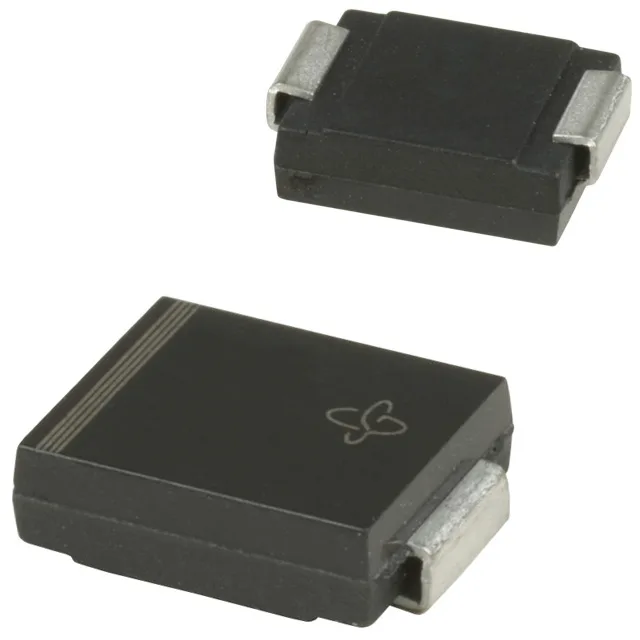
1500 W peak pulse at 10/1000 µs — what the clamping stack means
The 1.5SMC6.8AHM3_A/H: The 5.8 V standoff sits below the 6.45 V minimum breakdown, leaving headroom for the circuit to operate cleanly at normal bus voltages before the TVS begins conducting. Once a transient exceeds the breakdown threshold, the clamping voltage is held to a maximum of 10.5 V across the load. The 1.5 kW peak-pulse number is the standard TVS specmanship figure; the actual clamping voltage the downstream IC sees during a surge is 10.5 V maximum.
AEC-Q101 and the 150 °C junction ceiling
AEC-Q101 qualification means this part passed the automotive reliability stress suite — temperature cycling, high-temperature reverse bias, surge and ESD — at the wafer level. An ECU mounted near the engine block that hits 125°C ambient still has 25°C of junction margin above the case. The series name TransZorb® is Vishay's trademark for their glass-passivated die TVS construction — the glass passivation gives the junction better stability under repeated surge stress compared to an unpassivated Zener junction.
DO-214AB SMC — assembly and board-fit context
Surface-mount DO-214AB (SMC) lands on the board like any standard J-lead — reflow profile follows the paste and board stack-up, not the TVS itself. The Tape & Reel packaging suits high-volume assembly runs. The base product number 1.5SMC6.8 is the series anchor; the H, M3, and A/H suffixes carry the grade and packing variant — confirm the exact suffix against the BOM line before committing.
No official Vishay cross-reference or pin-compatible successor is listed in the ledger for this exact order code.