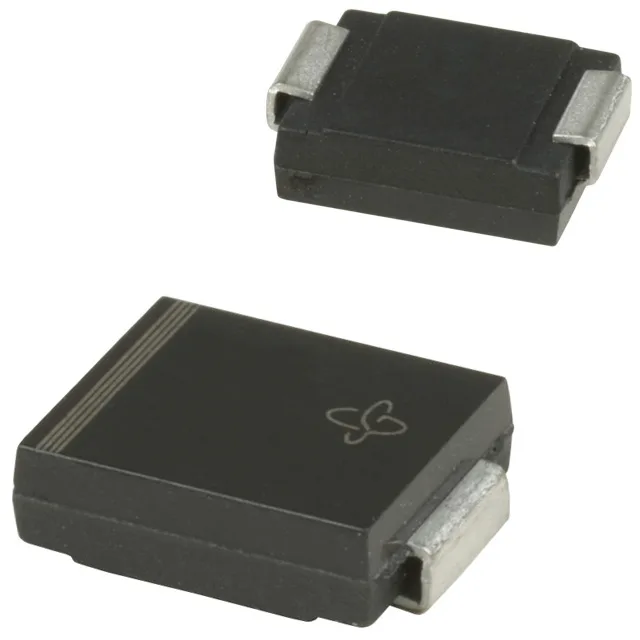
What the voltage ratings mean for transient suppression
The 1.5SMC6.8AHM3/I: This part is unidirectional — it protects a single polarity. The 5.80 V standoff and the 6.45 V breakdown place it in the low-voltage rail protection category, typical for 5 V and some 12 V automotive supply rails. Power line protection is flagged No in the spec table — the design intent is local clamping at the protected node, not bus-level surge diversion across the full power distribution network.
AEC-Q101 grade and thermal margins for under-hood deployment
The automotive series designation and AEC-Q101 qualification mean the die and packaging have passed temperature cycling, surge life, and humidity stress testing that standard commercial TVS parts skip. Commercial-grade Zeners rated to 150°C ambient fall short in that combined scenario; the junction limit here gives headroom that a datasheet-max figure alone does not. Automotive and telecom are the listed applications. Automotive means exposure to load-dump transients, cold-crank events, and temperature extremes — the 1.5 kW peak pulse and 143 A surge rating are sized for that threat profile. Telecom deployment adds ESD and lightning-surge protection on data and power rails in outdoor equipment — a different stress signature but the same clamping mechanism.
Package, mounting, and tape-and-reel handling
The DO-214AB (SMC) package with surface-mount termination suits standard solder-reflow assembly — the tab-style cathode termination requires adequate thermal land pad design under the body to conduct heat away from the junction during clamping events. Tape-and-reel packaging is the standard automotive reel size, suitable for high-volume pick-and-place without hand-placement handling.