AEC-Q101 qualification — what it signals for automotive BOMs
The 1.5SMC6.8AHE3/9AT: AEC-Q101 is the automotive stress qualification for discrete semiconductors — it certifies the part passed temperature cycling, humidity bias, and surge testing aligned to the USCAR-2 current-temperature profile used in engine-compartment and chassis harnesses. For a BOM entering IATF 16949 or AS9100-controlled builds, an AEC-Q101 part removes the qualification-loop variable that a commercial-grade TVS would require additional screening to satisfy. The Automotive classification in the series name and the wide junction temperature range are the design-anchor signals a systems architect uses to confirm the part clears the temperature gate for under-hood deployments without derating to the point of losing the protection function. There is no official second-source order code cross-referenced in the ledger for this specific polarity and clamping voltage — the base product number 1.5SMC6.8 covers the family, but the HE3 suffix carries specific lot-traceability and automotive test-coupon requirements that may not be mirrored by a generic SMC-body alternative. Confirm the suffix-level part if dual-sourcing for safety-critical automotive designs.
SMC package — board integration reality
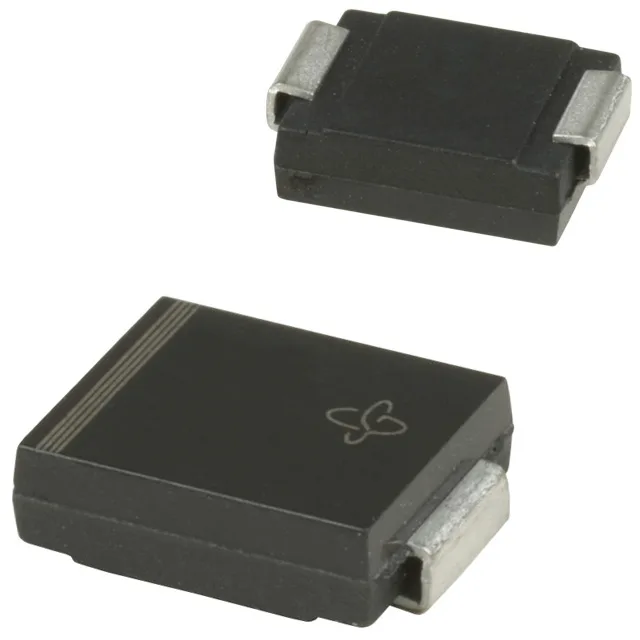
The DO-214AB (SMCJ) package is the standard SMC outline — it mounts in the same footprint as the SMA and SMB families but the SMC has a higher peak pulse rating than SMA and a lower capacitance than SMB in this voltage class, making it the preferred balance for CAN/LIN and 5 V power rail protection where the capacitance loading on the line must stay below the bus-spec limit. Solder joint integrity on the large cathodic tab is the primary failure mode in vibration-heavy deployments — the thermal cycling difference between the copper tab and the board laminate drives the fatigue. A board-level temperature cycle test per JEDEC JESD22-A104 Condition G or H is the standard qualification screen; for production boards using lead-free solder, the DPAK-class tab size means the reflow profile must allow time for the full solder wetting front under the tab, not just the peripheral lands.
Sourcing posture and lifecycle
No official second-source or pin-compatible alternative is cross-referenced by Vishay for the HE3 suffix at this clamping voltage — any alternate must clear AEC-Q101 lot screening independently before entering a safety-critical automotive BOM. The T&R packaging is standard reel tape-and-reel for high-volume SMT assembly; confirm the reel size and peeling force with your assembly house if changing from a cut-tape source.