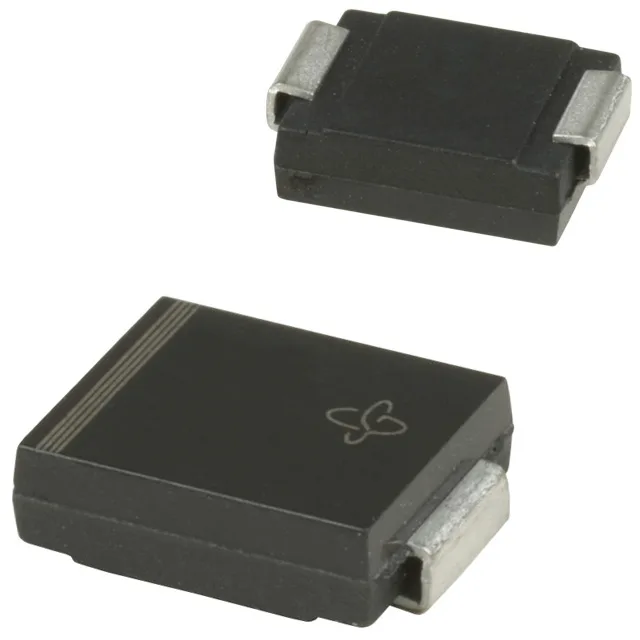
What the 1.5SMC series protects and why the voltage window matters
The 1.5SMC6.8AHE3/57T is a unidirectional transient voltage suppressor in the Automotive, AEC-Q101, 1.5SMC, TransZorb® series. It clamps voltage spikes on a single protected rail, shunting the surge current away from whatever load sits behind it. The 6.45V minimum breakdown is the threshold where the device begins conducting — below it, the TVS stays off and leaks only nanoseconds of standby current. For a 5V rail, that 10.5V maximum is a reasonable margin above the rail — the protected IC must survive that clamping voltage at its pins, which is the pass/fail criterion for specifying this part in an automotive ECU.
AEC-Q101 grade and the temperature envelope
The AEC-Q101 qualification means this part passed the automotive stress tests — temperature cycling, humidity, surge, and electrical overstress — defined by the Automotive Electronics Council. It is not a commercial-grade part with an automotive datasheet; the wafer fabrication and screening flow are purpose-built for the under-hood environment. The TJ suffix is important — the 150°C ceiling is the junction, not the ambient, so the board thermal design determines how much headroom remains in a hot compartment.
The base product number 1.5SMC6.8 points to the standard automotive series — any 1.5SMC6.8A variant in the same voltage grade is a candidate cross-reference, but the exact clamp voltage and peak current must be verified against the specific datasheet before substituting.