AEC-Q101 qualification — what it means for the BOM
The 1.5SMC56AHM3/I: This part carries the Automotive, AEC-Q101, 1.5SMC, TransZorb® series designation. AEC-Q101 is the stress-test qualification standard for discrete semiconductors used in automotive electronics — it mandates a defined temperature grade, ESD sensitivity classification, and reliability screening (including high-temperature reverse bias and temperature cycling) that an industrial-grade pass does not undergo. For an OEM auditor reviewing PPAP documentation, this is the entry-level qualification proof; the part is rated for the -65°C~150°C(TJ) operating range, which covers under-hood and engine-compartment ambient conditions where junction temperature can exceed 125°C during a summer load-dump event.
1500 W peak pulse — the surge-handling story
The reverse standoff voltage is 47.8V, and the breakdown voltage starts at 53.2V (min), so the device remains transparent to the 48 V nominal bus and only conducts during a surge event that exceeds 53.2 V. For a 48 V automotive battery line or a 48 V telecom rail, this is the correct voltage class — the standoff sits above the steady-state rail, and the clamp stays below the downstream IC's absolute-max rating.
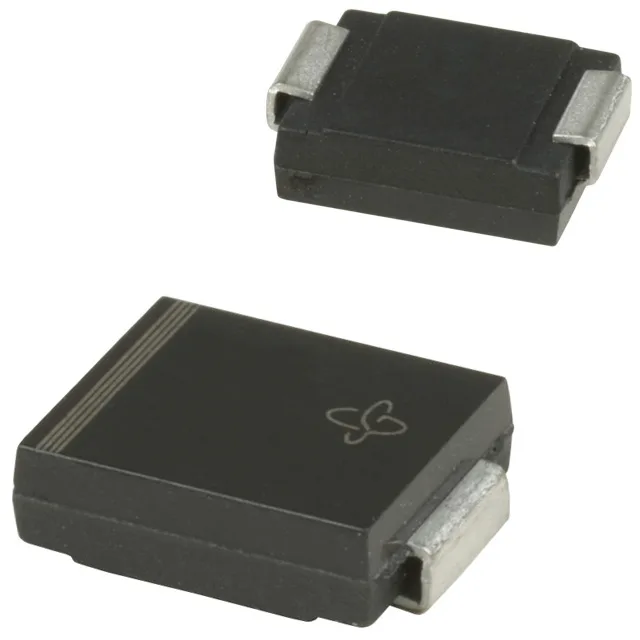
The SMC body measures roughly 7.1 mm × 6.2 mm with a 2.6 mm seated height, and the cathode tab on the top surface serves as the primary heat path. The copper pad area under the package on the PCB must be sized per the datasheet's recommended land pattern to keep the thermal impedance low enough for repetitive surge handling; a 1-oz copper pour of at least 50 mm² per terminal is typical for this power class. The unidirectional configuration (1 channel) means the device is polarity-sensitive — the cathode band must face the positive rail.
Lifecycle status is Active per the manufacturer's listing. This is not a last-time-buy or EOL part — Vishay continues to manufacture the 1.5SMC56AHM3/I under the TransZorb® family.