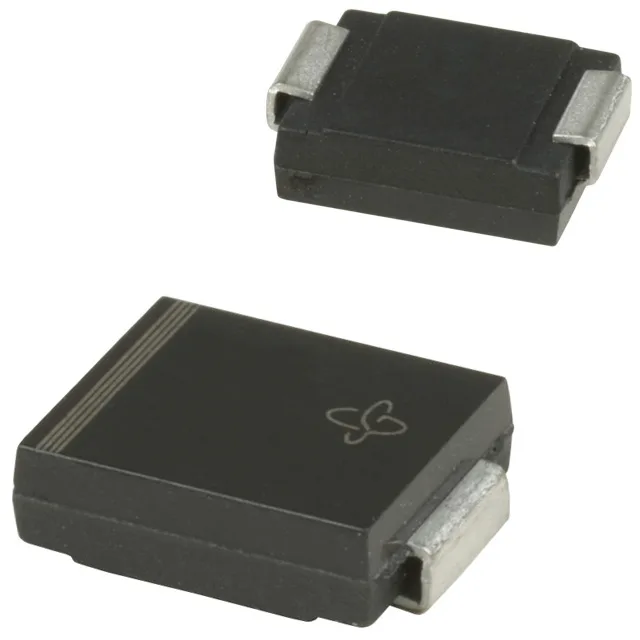
The 1.5SMC43CAHM3/H: For a BOM cost engineer, the active status removes the single-source obsolescence panic that hits when a TVS goes NRND mid-production. The allocation risk here is purely market-driven — lead times stretch when automotive demand spikes, not because the line is shutting down.
1500W peak pulse — what the rating actually means
Rated for 1500 W peak pulse power dissipation under the 10/1000 µs waveform — this is the industry-standard surge test for TVS diodes. The 25.3 A peak pulse current at that waveform tells you the diode can clamp a 59.3 V transient without exceeding its thermal limit. The 40.9 V minimum breakdown voltage is where avalanche conduction starts; the 59.3 V clamping voltage is the peak the protected circuit sees during the surge.
Automotive AEC-Q101 — the reliability grade
Qualified to AEC-Q101, the automotive discrete semiconductor stress-test standard. The TransZorb® series is Vishay's branded TVS platform, known for tight clamping ratio and low leakage. The bidirectional channel means a single device protects a signal pair or a differential bus — one part number covers both polarities of the transient.
DO-214AB (SMC) — board-fit and sourcing
The tape-and-reel delivery suits automated pick-and-place for high-volume automotive or telecom board assembly. Applications listed are Automotive and Telecom — both environments where repetitive surge events (load dump, lightning-induced transients on communication lines) demand a TVS with a 1500 W pulse rating and wide temperature margin.