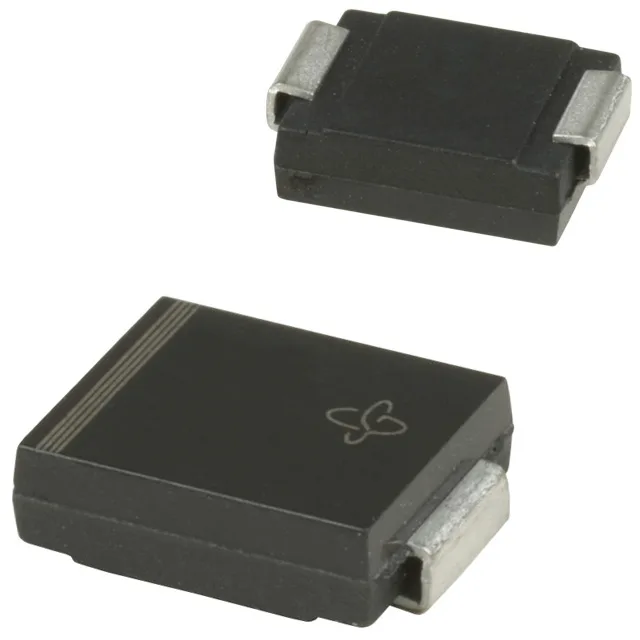
The 1.5SMC30A-M3/9AT: No allocation signal or spot premium on this line today.
Protection envelope — 25.6V rail, 41.4V clamp
With a 25.6V reverse standoff voltage, this TVS diode sits on a 24V nominal DC rail without conducting in standby — the leakage at 25.6V is negligible. When a transient exceeds the 28.5V minimum breakdown voltage, the Zener junction avalanches and clamps the surge to 41.4V maximum at the rated peak pulse current of 36.2A (10/1000µs waveform). That 1.62 clamping factor (Vc/Vbr) is typical for a TransZorb — tight enough to protect downstream 40V-rated semiconductors without extra margin. The 1500W peak pulse power rating defines the energy the diode can absorb in a single transient event. For a 24V industrial control board or a 24V telecom line card, this one-device solution handles the IEC 61000-4-5 surge level without a secondary clamp stage.
Package and board-fit — DO-214AB SMC
The supplier device package is listed as DO-214AB (SMCJ), meaning the solder pad layout and stencil aperture are interchangeable across the industry. Surface-mount reflow profile follows standard Pb-free ramp rates; no special handling beyond MSL level 1 (typical for molded SMC packages).
Unidirectional — single-channel DC rail protection
This is a unidirectional TVS, meaning it clamps positive transients above breakdown and conducts forward like a standard diode for negative surges. For a positive-ground or bipolar rail, a bidirectional variant (1.5SMC30CA) would be the correct choice — the unidirectional part is optimized for a single-polarity DC bus where the cathode connects to the rail and the anode to ground. The 1.5SMC series includes both unidirectional and bidirectional options across the same voltage range, so swapping between them is a BOM-line change only — same package, same footprint, same 1500W rating. The TransZorb trademark indicates Vishay's proprietary silicon avalanche process, which delivers a lower clamping voltage than generic Zener TVS diodes at the same power level.
Sourcing posture — active line, no allocation signal
With an Active lifecycle and no NRND flag, the 1.5SMC30A-M3/9AT is not in the allocation window. The 1.5SMC series is a high-volume Vishay line with multiple package options (SMC, SMA, SMB) and voltage variants — production capacity is stable. The Tape & Reel packaging is the standard 850/reel quantity for SMC diodes — no special packaging lead time. Quoted to order against your quantity; availability confirmed at RFQ.