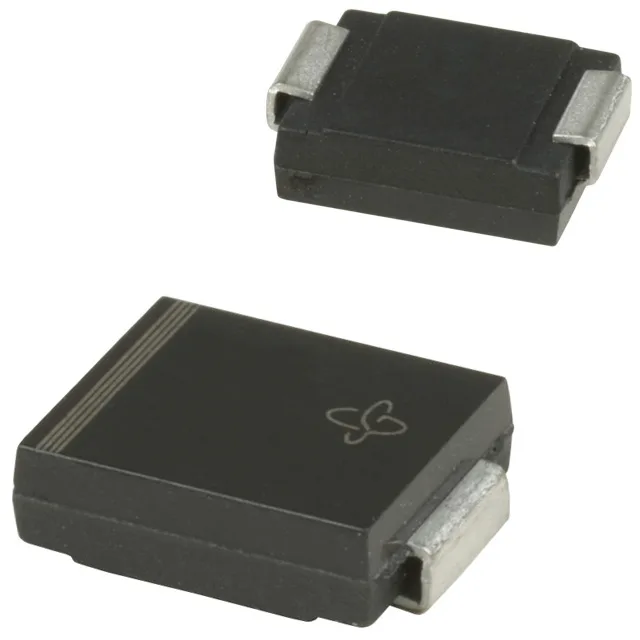
Active production — AEC-Q101 TVS for automotive and telecom
The 1.5SMC250AHM3_A/I: That clamping ceiling is the number the board designer checks against the downstream IC's absolute-maximum rating — if the protected device's V_max is below 344V, this TVS will not clamp fast enough to save it.
DO-214AB package — rework and board-fit notes
The pad footprint under the tab should have thermal vias to an inner-layer copper plane; without them the junction temperature rise during a surge event will exceed the 150°C limit faster than the datasheet pulse derating curve assumes. From a rework standpoint, the SMC body is large enough that a standard hot-air nozzle at 300°C will reflow the solder joints without cooking the adjacent passives. The cathode band is clearly marked on the body — orientation is unambiguous under a microscope. Will it survive the hot air? Yes, as long as the board has a thermal relief on the cathode pad to keep the heat from sinking into the plane.
AEC-Q101 compliance is the key authority signal for automotive procurement — it certifies the part meets the stress-test sequence defined by the Automotive Electronics Council for discrete semiconductors. The TransZorb® designation is Vishay's proprietary TVS technology, not a generic Zener; the avalanche response is tighter than a standard Zener's for surge clamping.