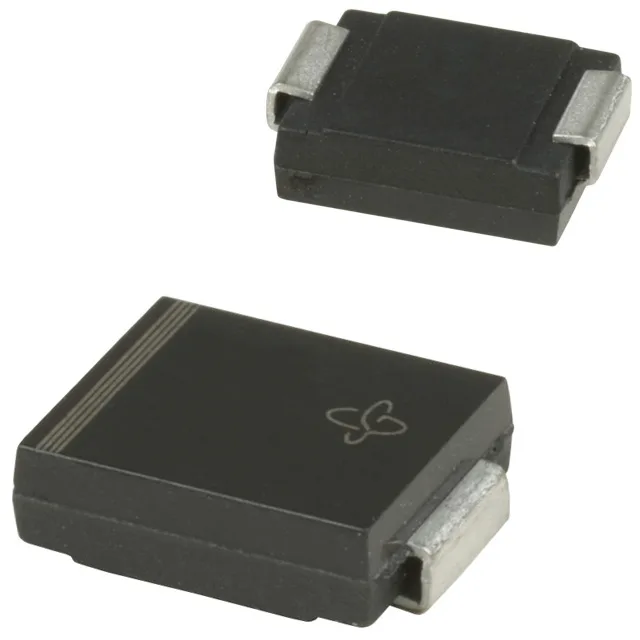
TVS diode, 1500 W, bidirectional, automotive grade
The 1.5SMC22CAHE3_A/I: This is a single-channel bidirectional device, meaning it protects signal or power lines against both positive and negative overvoltage events without needing two diodes back-to-back. The 1500 W rating means it can absorb substantial surge energy — enough for automotive load-dump and ISO 7637-2 transients in an ECU or sensor module.
Automotive qualification and temperature range
The 1.5SMC22CAHE3_A/I carries AEC-Q101 qualification, the automotive-grade stress and reliability standard for discrete semiconductors. This means it has passed temperature cycling, ESD, and high-temperature reverse bias tests required for under-hood and in-cabin electronics. Vishay lists this part as Active in production.
DO-214AB package and board fit
Housed in a DO-214AB (SMC) package, the same footprint as the SMCJ industry standard. The surface-mount body is reflow-solderable and fits standard pick-and-place equipment. The bidirectional marking is unambiguous — no cathode band to get wrong in a rush, which matters when you are swapping this on a board without a schematic in front of you.