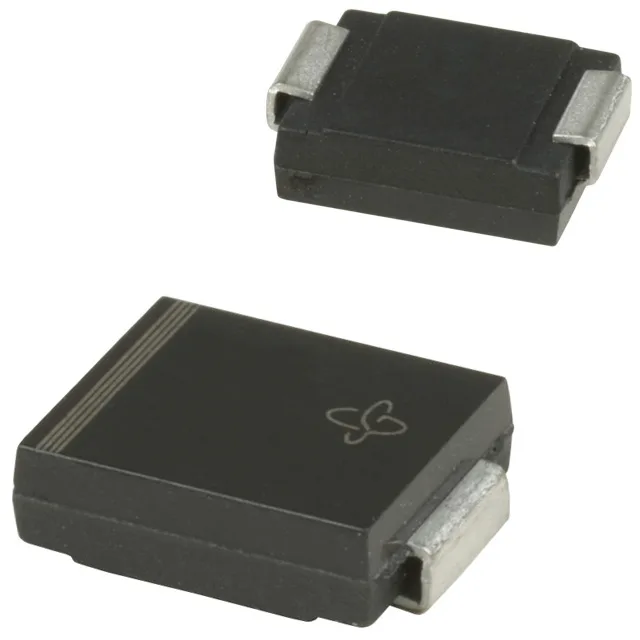
1500 W peak pulse, AEC-Q101 qualified
The 1.5SMC20AHM3/I: It clamps at 27.7 V maximum with a peak pulse current of 54.2 A, and its reverse standoff voltage is 17.1 V — the maximum DC voltage it can pass without conducting. The breakdown voltage range starts at 19 V minimum, so a 12 V or 15 V rail stays well below the trigger threshold. This part carries AEC-Q101 qualification and is marked for automotive and telecom applications. The -65°C to +150°C junction temperature range covers under-hood and outdoor enclosure thermal profiles. The DO-214AB (SMC) package is a standard surface-mount footprint for high-reliability TVS diodes, with a low profile suitable for dense PCB layouts.
The 27.7 V maximum clamping voltage is the voltage the TVS forces the protected line to during a surge. For a 24 V nominal supply, this stays within typical semiconductor absolute-maximum ratings, but a 12 V rail needs a lower-voltage TVS to avoid damage. The 54.2 A peak pulse current at the 10/1000 µs waveform defines the surge capability — a 1500 W part at 27.7 V clamp yields that current by design. On a 24 V rail, the standoff is too low — the TVS would conduct continuously. The breakdown voltage minimum of 19 V confirms the trigger point; the TVS starts clamping above 19 V and fully clamps at 27.7 V.
The AEC-Q101 qualification means each device is tested to automotive-grade reliability: temperature cycling, ESD, and high-temperature reverse bias. For designs requiring a known-good TVS with a standard DO-214AB footprint, this part is a drop-in for the 1.5SMC20 family.