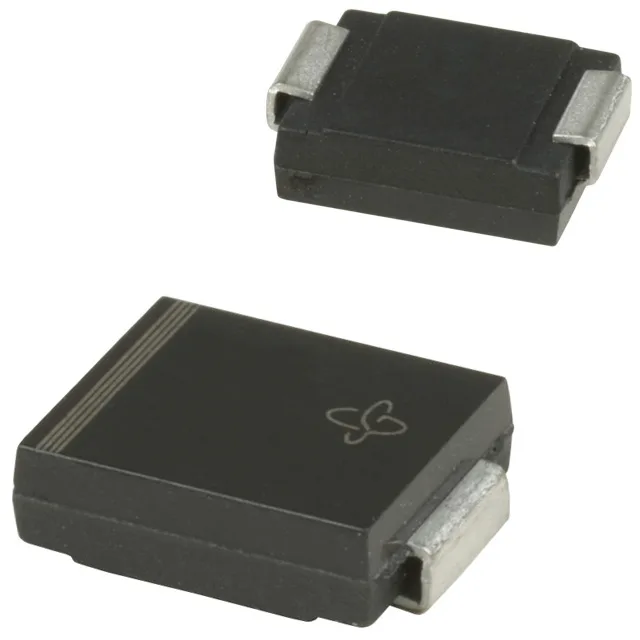
1500W peak pulse, 171V standoff — the protection window for a 171V DC rail
The 1.5SMC200CAHE3/9AT: This defines the protection envelope for a 171V nominal DC bus or 120VAC rectified line in automotive or industrial 24V/48V systems where load-dump and inductive kickback exceed the rail.
AEC-Q101 Grade 0 — the temperature band that matters for under-hood placement
Qualified to AEC-Q101, the automotive discrete semiconductor stress standard, this part operates across a -65°C to +150°C junction temperature range. That Grade 0 temperature profile covers engine-bay ambient of 105°C with margin for self-heating during a surge event — the die sees 150°C at peak pulse without exceeding the abs-max rating. The DO-214AB (SMC) package footprint is shared across the 1.5SMC family, so a single PCB land pattern serves the full voltage range from 6.8V to 440V standoff.
Active lifecycle — no last-time-buy pressure for new BOMs
The 1.5SMC series has been Vishay's mainstream 1500W TVS platform for over a decade, and the AEC-Q101 variant (HE3 suffix) is the automotive-grade branch. No official successor or second-source cross-reference exists — the part is the current production version. Sourced against RFQ through authorized and independent distribution channels; lot traceability and date-code consistency are confirmed at quote time.
Bidirectional channel — one device clamps both polarities on a signal pair
A single bidirectional channel means the breakdown characteristic is symmetrical: the 190V min breakdown voltage applies in both directions, and the 274V clamping voltage is identical for positive and negative transients. This suits AC-coupled data lines (CAN bus, RS-485, Ethernet PHY magnetics) or a DC rail where reverse polarity protection is already handled upstream — the TVS handles the surge regardless of polarity without needing back-to-back series diodes.
The specification explicitly states Power Line Protection: No. This means the 1.5SMC200CAHE3/9AT is designed for secondary-side transient suppression on DC buses and signal lines, not for AC mains input protection. The 1500W peak pulse rating at 10/1000µs is the standard telecom/signal surge waveform; a mains transient (8/20µs or 10/350µs) would exceed the device's energy capability. For automotive 12V/24V load-dump protection (ISO 7637-2 pulse 5a/5b), this part sits downstream of the alternator rectifier, not at the battery input.