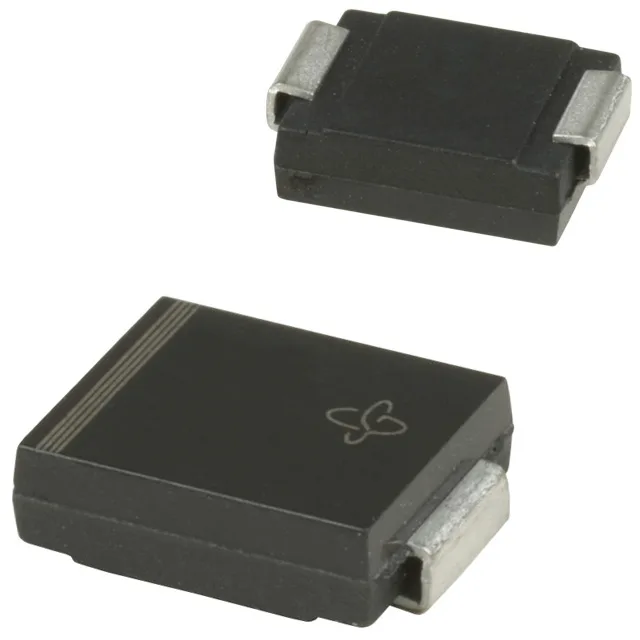
1500 W bidirectional TVS for general-purpose rail clamping
The 1.5SMC16CA-E3/57T: Its 13.6 V reverse standoff voltage and 22.5 V clamping ceiling make it a fit for 12 V nominal supply rails where a transient needs to be shunted before it reaches downstream silicon. The single bidirectional channel means one device clamps both polarities — no need to pair two unidirectional parts for AC-coupled or floating lines. The 66.7 A peak pulse current rating at the 10/1000 µs test pulse tells you the die can sink a substantial surge before the clamping voltage rises above the 22.5 V ceiling.
Clamping voltage and breakdown margin
The minimum breakdown voltage is 15.2 V, with the reverse standoff at 13.6 V — a 1.6 V guard band between normal rail operation and the onset of avalanche. A 12 V bus riding at 13.2 V under regulation still sits below the standoff threshold, so the TVS stays high-impedance during normal operation and only conducts when a transient pushes the rail above 15.2 V. At the 66.7 A peak pulse current the clamping voltage hits 22.5 V max — this is the voltage the protected circuit must survive. A downstream DC-DC converter with a 25 V abs-max input sees a 2.5 V margin; a 20 V-rated part would need additional series protection or a lower-clamping TVS.
DO-214AB SMC footprint and temperature range
Housed in the DO-214AB (SMCJ) package, this is a surface-mount device with a standard JEDEC footprint. No power line protection rating — this part is intended for signal and low-power rail clamping, not for direct mains or high-energy AC line suppression. The 1500 W rating is a peak pulse figure, not continuous dissipation; derate for ambient temperature above 25°C per the manufacturer's curve.
Active production and sourcing posture
Store the reels in dry conditions per the moisture sensitivity level on the reel label — the SMC body is not hermetic, and absorbed moisture can cause package cracking during reflow.