Transient protection for 128V automotive and telecom rails
The 1.5SMC150AHM3_A/I: Its 128V reverse standoff voltage and 143V minimum breakdown voltage mean it clamps transients on nominal 128V DC buses — common in 48V telecom rectifiers and 24V automotive systems with boost converters — before they reach downstream silicon. The clamping voltage is 207V at a peak pulse current of 7.2A, limiting the let-through energy to a level that protects downstream MOSFETs and ICs rated for 250V or higher. This is a single-channel device (one unidirectional channel), so it protects one rail per package.
AEC-Q101 qualification and temperature range for underhood duty
Qualified to AEC-Q101, the automotive discrete semiconductor stress-test standard, this TVS is rated for operation from -65°C to +150°C junction temperature. That covers the full underhood ambient range — a transmission control unit or engine ECU sees 125°C ambient on a hot day, and the 150°C junction rating provides margin for self-heating during a transient event.
DO-214AB SMC footprint and board integration
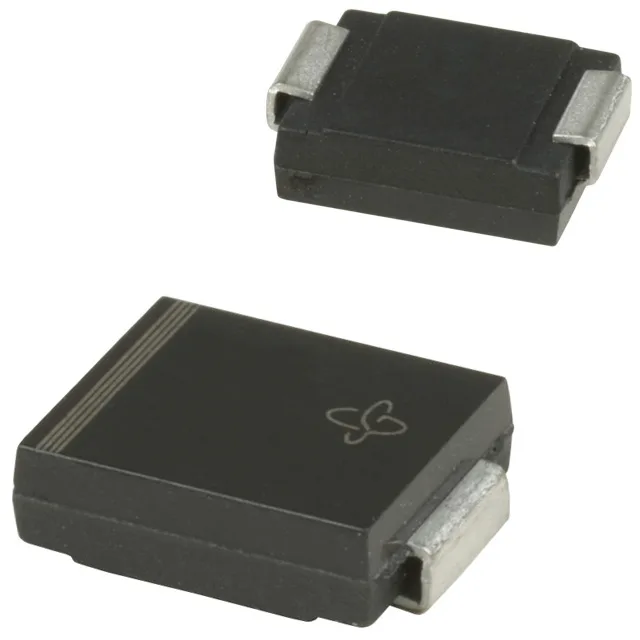
Housed in the DO-214AB (SMC) surface-mount package, the device has a standard footprint that reflows on a 0.063-inch thick PCB with typical soldering profiles. The copper pad area under the cathode tab sets the thermal resistance to ambient — a larger pad improves heat dissipation during repetitive transients, though the 1500W rating assumes a single non-repetitive pulse at 25°C. Mounting is surface mount, consistent with automated pick-and-place assembly for automotive ECU and telecom line-card production.