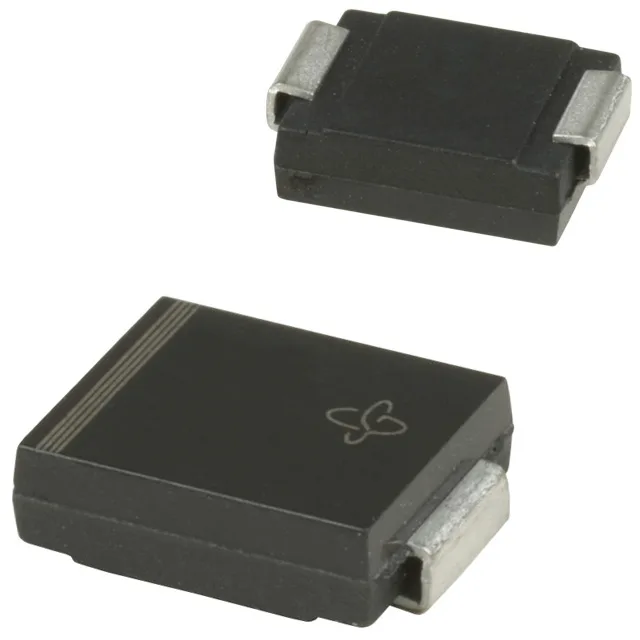
1500 W peak pulse, AEC-Q101 — the TVS for 128 V rails in automotive and telecom
The 1.5SMC150AHM3_A/H: It clamps a 128 V reverse standoff rail at 207 V max, passing 7.2 A peak pulse current before the silicon breaks down. AEC-Q101 qualification means it is screened for automotive-grade reliability: the -65°C to 150°C junction temperature range covers under-hood and engine-bay thermal profiles without derating the pulse capability.
Clamp voltage and standoff — sizing the protection window
The 128 V reverse standoff (working voltage) is the DC or peak-AC rail the TVS sits across without conducting. The 143 V minimum breakdown voltage guarantees the diode starts clamping before the rail exceeds the downstream components' absolute maximum — a 150 V-rated MOSFET on a 128 V bus has margin. At 207 V max clamping, the TVS holds the surge voltage below the 250 V typical rating of common DC-link capacitors and downstream semiconductors in automotive 48 V or telecom -48 V systems. The 7.2 A peak pulse current is the current the diode must sink at the clamp voltage — the upstream fuse or PTC must open before the diode's thermal limit.
Package and board-fit — DO-214AB (SMC) footprint
The DO-214AB (SMC) package is a standard surface-mount footprint for 1500 W TVS diodes. The large copper tab on the cathode side carries the heat into the PCB copper pour — a 1 oz copper pad of at least 300 mm² keeps the junction temperature rise under 25°C during a single 10/1000 µs pulse. Supplied on Tape & Reel, the part is compatible with standard pick-and-place and reflow profiles (260°C peak, J-STD-020). No special moisture sensitivity level is stated, but a 24-hour bake at 125°C before reflow is prudent if the reel has been open longer than the floor life.