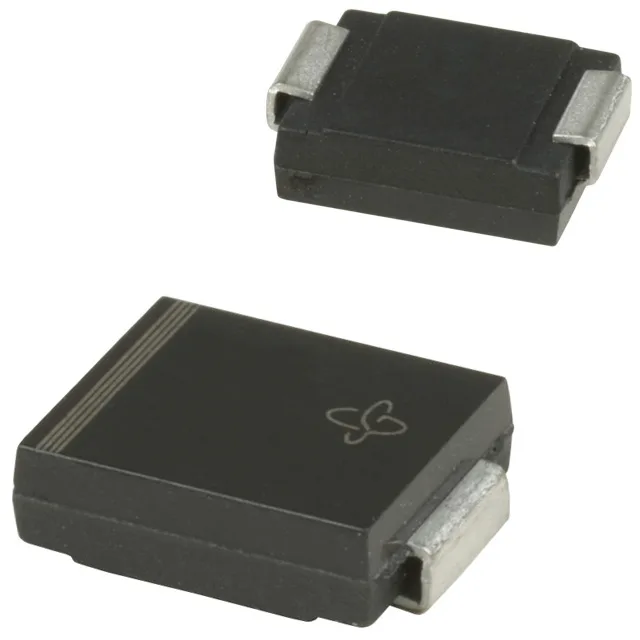
Automotive-grade TVS for 128 V rails
The 1.5SMC150AHM3/I is a 1500 W peak-pulse TVS Zener from Vishay's 1.5SMC series, housed in a DO-214AB (SMC) surface-mount package. It is qualified to AEC-Q101, the automotive-grade discrete semiconductor reliability standard, which means it is screened for the temperature, vibration, and lifetime requirements of under-hood and chassis-mounted electronics.
Pulse power and clamping — what the ratings mean
The 1500 W peak-pulse power rating is specified with a 10/1000 µs exponential waveform — the standard TVS test condition. This means the device can absorb a single 7.2 A pulse that decays to half its peak in 1000 µs, clamping the line to 207 V. For shorter transients (e.g., 8/20 µs), the peak current capability is significantly higher, but the datasheet's derating curve for pulse duration must be consulted to stay inside the device's SOA. Above that, breakdown begins at 143 V minimum, and the device enters avalanche conduction, clamping the transient. For a 128 V bus, this provides a guard band of about 15 V before the TVS starts to conduct — enough to ride through normal ripple without wear.
AEC-Q101 and deployment context
For repetitive pulsing, the trace width and via count to the ground plane set the practical limit.