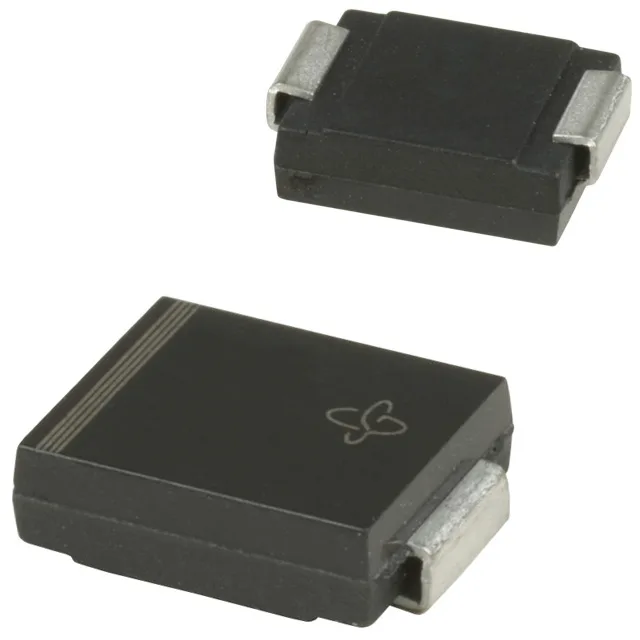
TVS diode with 1500W pulse rating and AEC-Q101 pedigree
The 1.5SMC130AHM3/I: Rated for automotive applications with AEC-Q101 qualification, the part operates across -65°C to 150°C junction temperature — the full under-hood ambient range plus margin for self-heating during a surge event.
What the 1500 W peak pulse rating means for protection margin
Clamping at 179 V maximum at 8.4 A peak pulse current means the downstream circuitry sees no more than 179 V during a transient — the lower the clamping voltage relative to the protected component's breakdown rating, the wider the safety margin. Breakdown occurs at a minimum of 124 V, ensuring the TVS starts conducting before the rail reaches a damaging level. The unidirectional configuration (single channel) clamps only positive transients; for AC or bidirectional protection, two devices or a bidirectional variant is needed.
Automotive qualification and deployment context
AEC-Q101 qualification means this TVS has passed automotive-grade stress tests: high-temperature reverse bias, temperature cycling, and ESD robustness per the standard. It is suitable for 12 V and 24 V vehicle electrical systems, telecom line cards, and industrial power buses where 111 V standoff provides margin for nominal 48 V or 60 V rails. The DO-214AB (SMC) package footprint is standard for 1500 W TVS diodes — the copper pad area on the PCB directly sets the thermal resistance to ambient, so the board layout must follow the recommended land pattern for full surge rating.
The 1.5SMC130AHM3/I is the automotive-grade variant — the standard-grade 1.5SMC130A shares the same die and package but lacks AEC-Q101 documentation.