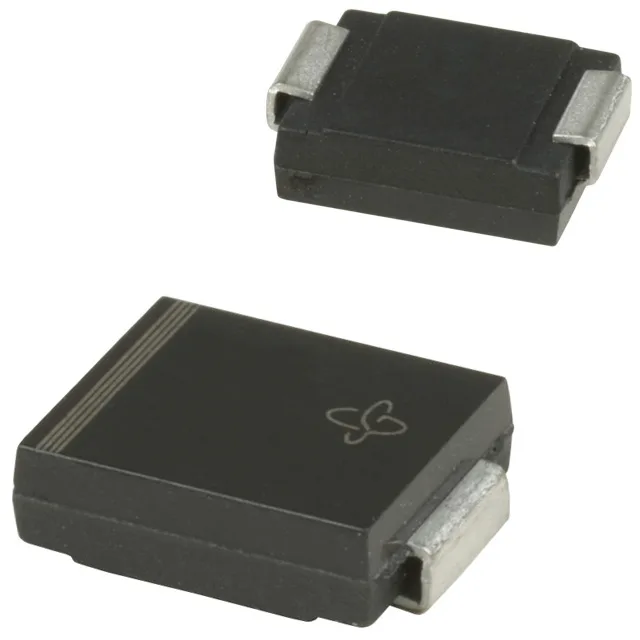
What the 1500 W peak pulse rating means for your protection budget
The 1.5SMC110CA-M3/57T: That 1500 W figure is the device's ability to absorb a transient surge without failing — it tells you the energy-handling capacity, not the steady-state dissipation. The 9.9 A peak pulse current is the maximum surge the diode can shunt at the rated waveform — if your transient source can deliver more current than that, the TVS may not survive the event. The breakdown voltage range starts at 105 V minimum, so the diode begins conducting somewhere above the standoff voltage but well before the 152 V clamp — this window defines the protection threshold. For a 94 V rail, the margin between normal operation and breakdown is about 11 V, which is typical for TVS diodes in this class.
DO-214AB package and surface-mount integration
Housed in a DO-214AB (SMC) package, the 1.5SMC110CA-M3/57T is a surface-mount device with a standard footprint shared across the 1.5SMC series. The package is rated for the full 1500 W pulse without derating at 25 °C ambient — at elevated temperatures, the peak pulse power must be derated per the manufacturer's curve. The wide range means the TVS can be placed on a board that sees thermal cycling from cold start to hot soak without shifting its breakdown voltage significantly. It is not intended for power line protection (the spec explicitly says 'No' for power line protection), so keep it on signal or low-voltage DC bus lines.