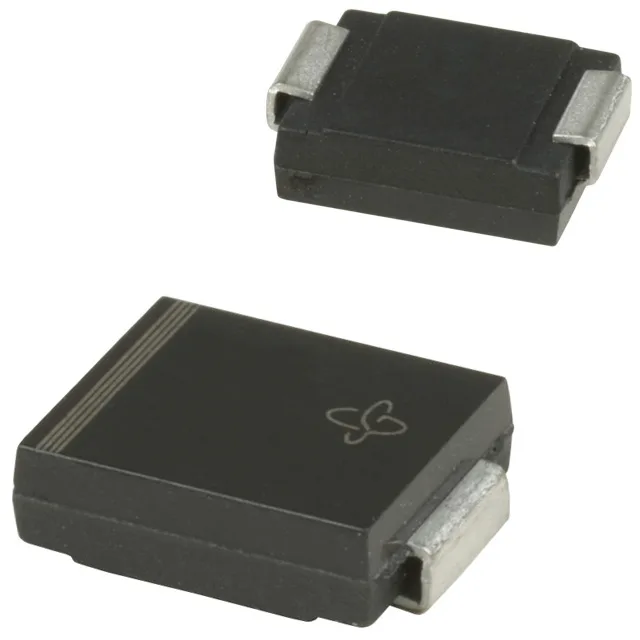
1500 W peak pulse in a DO-214AB footprint
The 1.5SMC10CA-M3/9AT: The single bidirectional channel means one device clamps both polarities — useful on AC-coupled or differential signal lines where polarity is not fixed.
Active production — no end-of-life watch needed
The base product number 1.5SMC10 covers the full family; the -M3/9AT suffix denotes the tape-and-reel packaging and the specific Vishay Green material set.
What the clamping numbers mean for rail protection
The reverse standoff voltage of 8.55 V is the maximum continuous DC voltage the TVS can sit across without conducting leakage current. Below that threshold, the device is effectively invisible to the circuit. The breakdown voltage range starts at 9.5 V — this is where the Zener junction begins to avalanche and clamp the transient. For a 5 V rail with a 7 V abs-max input rating, this TVS clamps well above the rail voltage — it is sized for the transient energy, not the steady-state rail. The 1500 W rating means it absorbs a single 10/1000 µs surge up to that power level without failing short. No power line protection — the device is intended for signal or low-voltage DC rail clamping, not AC mains.