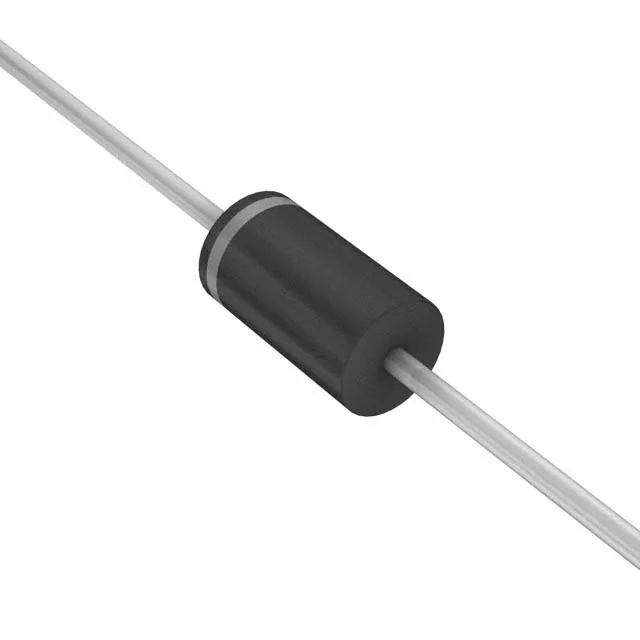
1500 W clamping envelope for 12 V automotive rails
The 1.5KE9.1AHE3_A/D: That standoff sits just above a nominal 12 V battery rail's steady-state tolerance — the diode stays dark during normal operation and only clamps when a transient pushes the line above 8.65 V breakdown, holding the clamp at 13.4 V maximum. For a 12 V system that sees load-dump or inductive kickback, this keeps the protected downstream silicon inside its abs-max rating.
AEC-Q101 and the -55 to 175 °C operating band
The DO-201AA axial through-hole package (also listed as DO-27) is a standard footprint; replacement or rework in a production board or field repair takes a soldering iron, not a hot-air station.
At the 10/1000 µs test waveform, the 1.5KE9.1AHE3_A/D handles a peak pulse current of 112 A. That is the current the diode shunts to ground during the clamp event — the 13.4 V clamping voltage times 112 A equals the 1500 W rating. For a real-world transient like a 12 V battery disconnect with an alternator still spinning, the diode absorbs the energy pulse and resets; it is not a crowbar device and does not latch. The 'Power Line Protection: No' flag in the spec means this TVS is designed for signal or low-impedance rail clamping, not for continuous overvoltage ride-through on a power bus.