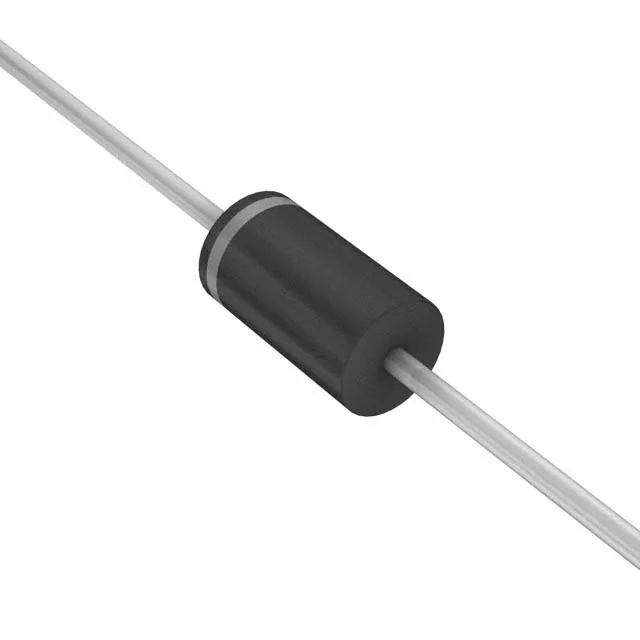
Obsolete — last-time-buy window closed
The 1.5KE8.2HE3/54: For a BOM that still calls out this part, the procurement path is a one-time buy against available inventory. No pin-compatible replacement from Vishay is documented, so a board-level change or a parametric substitute search is needed to close the gap.
1500W peak pulse — the clamping envelope
That 12.5 V is the voltage the downstream circuitry sees during the transient — a 12 V rail with a 13.2 V abs-max input would survive this, but a 5 V rail would need a secondary clamp or a different TVS. The standoff voltage is 6.63 V typical, meaning the TVS draws negligible leakage at the normal bus voltage. Breakdown starts at 7.38 V minimum — the Zener region where the device begins conducting to shunt the surge. The 6.63 V standoff sits well below a 12 V rail, so this part is typically used on lower-voltage automotive buses (e.g., 5 V sensor supplies or CAN bus lines).
AEC-Q101 — the automotive reliability screen
The HE3 suffix in the order code flags AEC-Q101 qualification — the automotive discrete semiconductor stress test suite (temperature cycling, HTRB, H3TRB, ESD). The TransZorb® series is a Vishay trademark for their silicon-avalanche TVS design. The 1.5KE package (DO-201AA axial lead) is a through-hole form factor — the leads are crimped or soldered into a PCB or terminal block. The axial body is rated for the full 1500 W pulse; the lead diameter and solder joint must handle the 120 A surge without fusing.