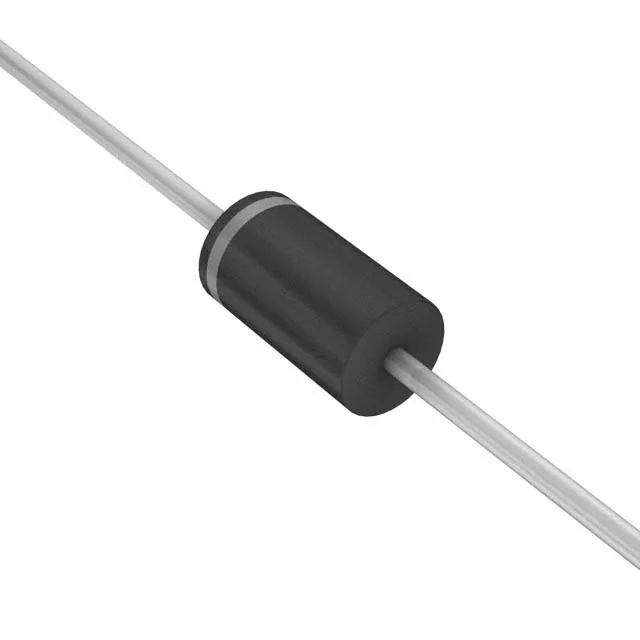
TVS that clamps hard and lives under the hood
The 1.5KE75CHE3/54: When the transient hits, it clamps at 109 V max while conducting 13.9 A peak — enough to absorb a load-dump spike or inductive kick without letting the protected circuit see the full surge. It is obsolete per the manufacturer, so new designs should look at current-generation Vishay TVS parts in the same TransZorb family. For existing BOMs, we source it through independent supply — confirmed genuine, lot-traceable, and quoted per RFQ.
What the ratings mean for your protection scheme
The 60.7 V reverse standoff is the maximum continuous DC voltage the diode lets pass without conducting — a 48 V nominal battery bus or a 60 V power rail sits safely below this threshold. Breakdown starts at 67.5 V min, so the diode begins shunting just above the normal operating ceiling. Clamping at 109 V max under the 13.9 A peak pulse current means the downstream circuitry must survive that voltage for the 10/1000 µs pulse duration. The 1500 W peak pulse rating is the product of clamp voltage and peak current — a standard metric for comparing TVS energy-handling across the 1.5KE series. The AEC-Q101 qualification means it passed the automotive stress tests — temperature cycling, high-temperature reverse bias, and ESD robustness per the standard.
Through-hole package — field-swappable without a hot-air station
The DO-201AA axial-lead package (also known as DO-27) is a through-hole form factor that can be swapped on site with a standard soldering iron — no hot air or reflow profile needed. The long leads and robust body make it a good fit for point-to-point wiring or terminal-block mounting in industrial control panels and automotive junction boxes.
Sourcing an obsolete automotive TVS
Vishay lists the 1.5KE75CHE3/54 as obsolete. For a BOM that already specifies this part, we source through independent distribution — units are verified genuine, RoHS-compliant, and lot-traceable.