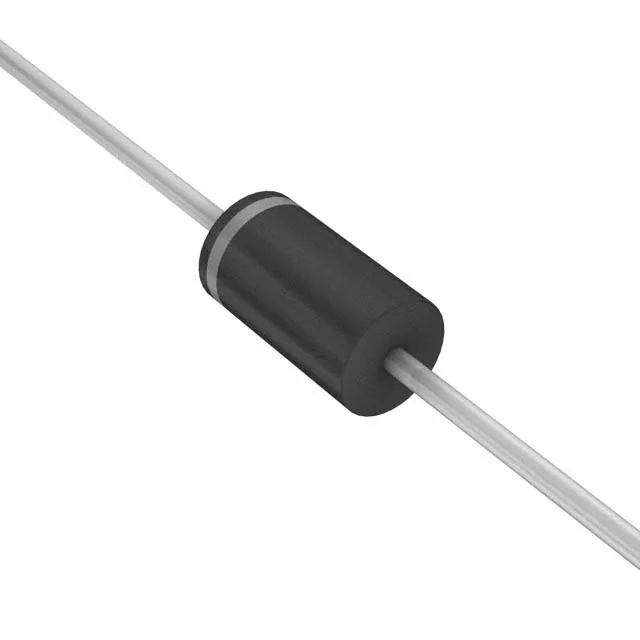
The 1.5KE7.5CAHE3/51: That 1500 W figure is the device's ability to absorb a single high-energy transient — a load-dump or inductive kick — without failing short. The clamping voltage at that peak current is 11.3 V, and the diode can handle 133 A of peak pulse current. For an automotive 12 V bus, the 6.4 V reverse standoff means it stays out of the circuit during normal operation and only conducts when a transient pushes the line above its breakdown threshold of 7.13 V. The 1500 W rating is a 10/1000 µs waveform figure — a standard industrial surge shape. For shorter pulses (8/20 µs) the peak power capability is higher, but the 10/1000 µs number is the one to use when comparing against other TVS diodes in the same test condition.
Automotive qualification and temperature envelope
The operating junction temperature range spans -55°C to 175°C, covering the full under-hood thermal profile including hot-soak conditions near the engine block. The DO-201AA axial-lead package is a through-hole format rated for the full 1500 W pulse — the lead frame and die attach are sized to handle the thermal shock of repeated transients without fatigue cracking. For high-vibration environments, the axial leads should be formed and seated against the PCB to avoid lead fatigue at the glass seal.
Sourcing an obsolete automotive TVS
Vishay has marked the 1.5KE7.5CAHE3/51 as obsolete. No official successor order code is recorded in the lifecycle entry. The AEC-Q101 qualification and the 1.5KE series footprint mean that a parametric replacement from the same family (same package, same 1500 W rating, same bidirectional configuration) is the practical migration path, but a board-level re-qualification is advised given the automotive safety context.