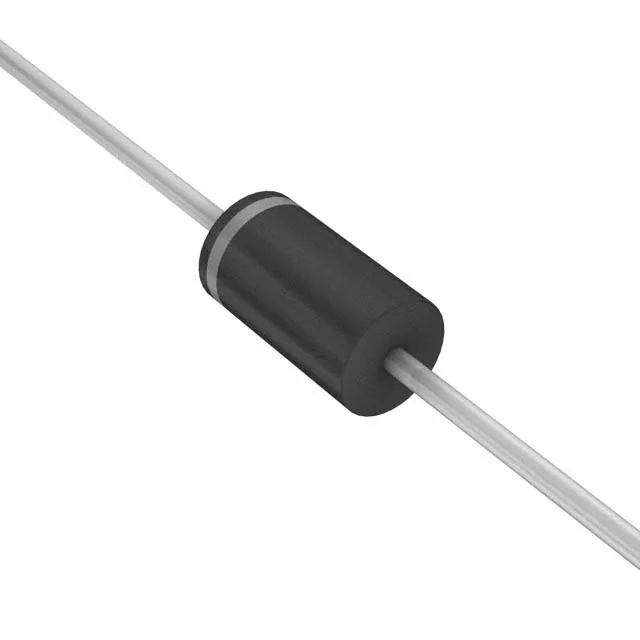
1500W TransZorb Zener TVS
The 1.5KE68-E3/54: This is the energy-handling spec that defines the part: it clamps a transient by shunting the surge current through the avalanche junction, and the 1500W rating tells you how much energy it can absorb before the junction temperature exceeds the safe limit. The 10/1000 µs waveform is the standard TVS test pulse — an 8/20 µs surge would see a higher peak current capability, but the 10/1000 µs rating is the one to use for BOM derating against the expected transient energy.
DO-201AA axial package and operating range
Housed in a DO-201AA (DO-27) axial-lead package, the 1.5KE68-/54 is a through-hole part. The axial body sits between two formed leads — the cathode band marks the unidirectional polarity. For a PCB layout engineer, the lead spacing and hole diameter follow the standard DO-201 footprint; the body length is about 9.1 mm, and the leads are typically 1.3 mm diameter tin-plated copper. The operating junction temperature range spans -55°C to +175°C, which covers industrial and some automotive under-hood environments. The 175°C max junction temperature is the thermal limit for the silicon die; derating the peak pulse power above 25°C follows a linear curve down to zero at 175°C. For a 85°C ambient, the effective pulse power capability drops to about 60% of the 1500W rating.
Obsolete — sourcing through independent channels
Vishay has marked the 1.5KE68-/54 as obsolete. No official successor order code is recorded in the lifecycle data. The 1.5KE series is a standard TransZorb family; a parametric replacement with the same standoff voltage and package can be cross-referenced, but a pin-compatible direct drop-in from another manufacturer is not guaranteed without board-level re-qualification. The tape-and-reel packaging (/54 suffix) indicates the part ships on a 13-inch reel for automated insertion. For a rework lab or small-batch build, the axial leads are hand-solderable with a standard iron — no special hot-air profile needed. The part is RoHS-compliant per Vishay's standard policy, but specific compliance documentation (REACH, UL) should be confirmed at the time of order against the actual date code.