Last-buy status — what it means for your BOM
The 1.5KE540A-E3/51: The 1.5KE540A-/51 carries a Last Buy lifecycle status from Vishay. This means the manufacturer has announced end-of-life and is accepting final orders within a defined window — after which the part will no longer be manufactured. For a BOM line using this TVS, the decision is whether to secure last-time-buy inventory for the remaining production run or to qualify a replacement. A replacement search should target a TVS with the same package (DO-201AA / DO-27 axial), a reverse standoff voltage of 459 V, and a peak pulse power rating of 1500 W — the same parametric envelope as this TransZorb device.
Clamping voltage and protection threshold
The reverse standoff voltage is 459 V typical, meaning the TVS draws negligible leakage current below this rail voltage. Above 459 V, the device begins to avalanche; the minimum breakdown voltage is 513 V, which is the guaranteed turn-on threshold. A 480 VAC or 400 VDC bus sits safely below the standoff, but a 500 V rail would keep the TVS in continuous breakdown — not a valid application.
Peak pulse power and thermal capability
The 2.03 A peak pulse current at the clamping voltage confirms the power rating — the product of Ipp and Vclamp equals the 1.5 kW rating within the waveform's duration. The operating junction temperature range spans -55°C to +175°C, which covers industrial and some automotive under-hood environments. Power derating applies above 25°C — at 175°C the peak pulse power capability drops to near zero, so the thermal environment of the board must be considered for repetitive transient exposure.
Package and board integration
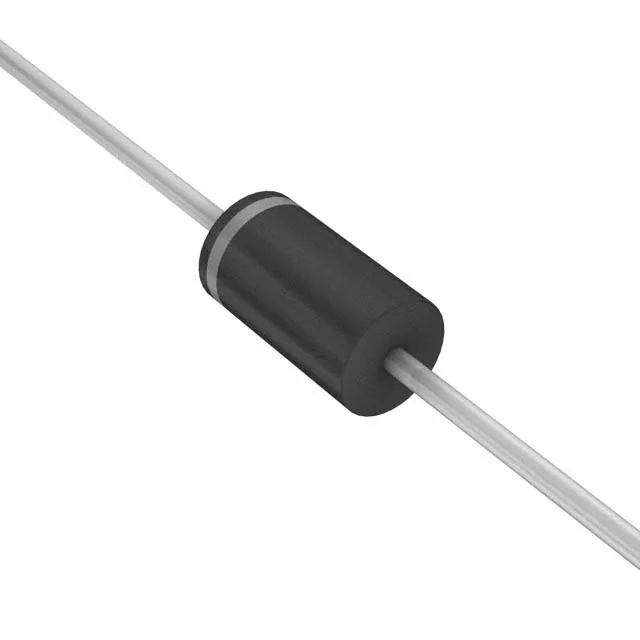
Housed in a DO-201AA / DO-27 axial-lead package, the 1.5KE540A-/51 is a through-hole device intended for hand-insertion or wave-solder assembly. The axial leads require hole diameters sized per the lead cross-section — typically 1.0 mm to 1.2 mm finished hole — and the body must be spaced off the board to allow airflow and avoid heat transfer during soldering. Supplied in bulk packaging, not tape-and-reel. This suits low-volume production, prototyping, or repair stock, but a high-volume pick-and-place line would need a different packaging option or a reel-compatible alternative from the same TransZorb family.