Voltage ratings and clamping behaviour
The 1.5KE47AHE3_A/D: The breakdown voltage is specified at 44.7V minimum, meaning the device starts conducting avalanche current before the protected rail exceeds 45V. The 40.2V reverse standoff is the maximum DC voltage the TVS can sit across without significant leakage — a 48V nominal bus with a 40.2V standoff part is a tight fit; this is sized for a 36V nominal rail with 40.2V as the continuous operating limit. At the 23.1A peak pulse current (10/1000µs waveform), the clamping voltage is 64.8V maximum. This is the voltage the downstream circuitry sees during the transient — the protected device must survive 64.8V for the pulse duration, or a secondary clamp is needed. Power line protection is marked 'No', which means this is a unidirectional TVS intended for DC rails, not for AC mains or bidirectional signal lines. The single unidirectional channel handles one polarity; for bipolar transients on signal lines, a bidirectional variant from the same 1.5KE family would be needed.
Package and rework reality
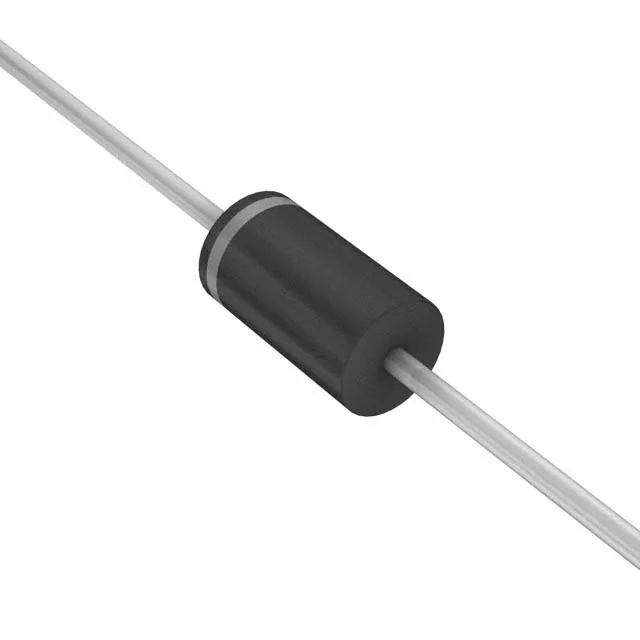
The DO-201AA (DO-27) axial leaded package is through-hole mounted — no hot-air rework needed, but the leads must be formed and inserted before wave soldering. The axial body is polarity-marked with a cathode band; orientation is unambiguous on the board.
Procurement and compliance
The AEC-Q101 qualification means the device has passed automotive-grade stress tests including temperature cycling, high-temperature reverse bias, and ESD robustness — documentation is available from Vishay upon request. RoHS compliance is standard for the TransZorb automotive series.