Clamping, standoff, and pulse current — what the ratings mean for rail protection
The 1.5KE43A-E3/73: The 36.8 V reverse standoff is the maximum DC or peak-AC voltage the diode blocks without conducting — a 24 V nominal rail with 30 % tolerance stays below this threshold, so the TVS sits off the line until a transient pushes it into avalanche. Breakdown starts at 40.9 V minimum; the diode fully clamps at 59.3 V, limiting the voltage the downstream circuitry sees. Peak pulse current is 25.3 A for the 10/1000 µs test waveform — this is the current the diode can sink while holding the clamp voltage. The 1500 W rating is the product of clamp voltage and pulse current at that waveform; shorter pulses (8/20 µs) allow much higher peak current, but the 10/1000 µs figure is the conservative design-in number for most industrial surge specs like IEC 61000-4-5. At elevated ambient the derating curve in the datasheet reduces peak pulse power linearly above 25 °C, so a hot enclosure (85 °C) derates the 1500 W rating to roughly 60 %.
DO-201AA axial — board-fit and mounting
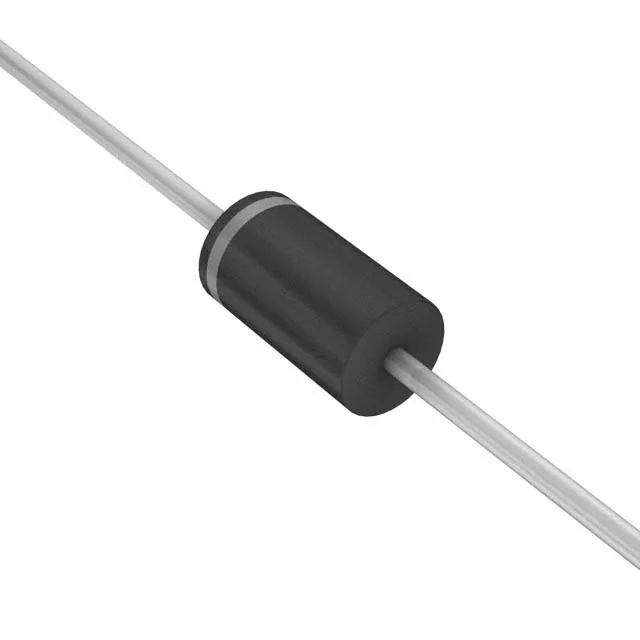
Housed in a DO-201AA (DO-27) axial-lead package, through-hole mount. The body diameter is about 5.3 mm with 25.4 mm lead spacing typical — fits standard 0.100-inch pitch holes on a proto board or production PCB. The axial form factor allows point-to-point wiring in high-reliability assemblies where surface-mount reflow is not an option.