Obsolete — sourcing through independent channels
Vishay has marked the 1.5KE20CAHE3/51 as obsolete.
Automotive-grade transient suppressor — what the ratings mean for fit
When a transient exceeds 19 V (the minimum breakdown voltage), the device clamps at 27.7 V maximum while shunting 54.2 A of peak pulse current (10/1000 µs waveform). The single bidirectional channel protects both polarities in one package, so a single device covers positive and negative transients on a signal or low-power bus without needing two unidirectional diodes back-to-back.
Package and board-fit — DO-201AA axial through-hole
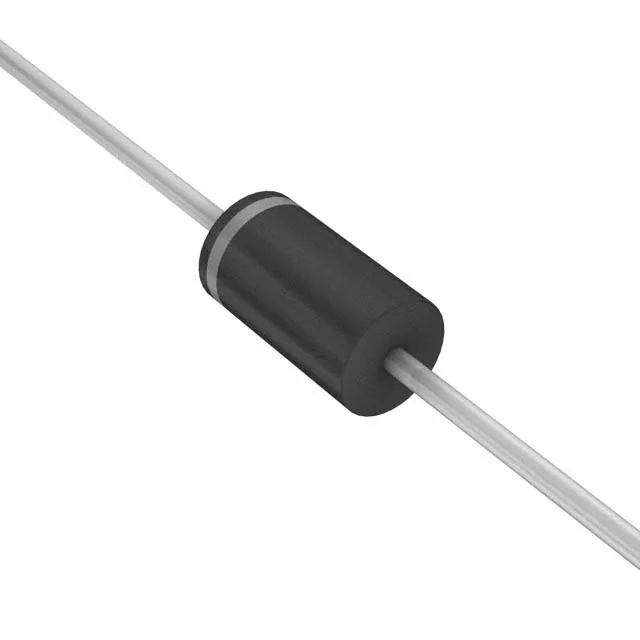
Housed in a DO-201AA (DO-27) axial leaded package, the 1.5KE20CAHE3/51 is a through-hole device. The axial body with wire leads solders into a board or terminal block — the lead spacing and hole diameter follow the standard DO-201 footprint, so it drops into existing layouts without a board spin. The operating temperature range spans -55°C to 175°C, covering the full under-hood automotive thermal profile. At the high end, the leakage current through the Zener junction will increase, but the junction itself is rated for continuous operation at 175°C.
No power line protection — signal and data bus duty
The datasheet explicitly states no power line protection — this TVS is designed for signal, data, or low-power DC bus protection, not for mains or high-energy AC line suppression. On a 12 V automotive sensor bus or a 15 V control rail, the 17.1 V standoff and 27.7 V clamp are a clean fit; on a 24 V truck system the standoff is too low.