What the 1.5 kW rating means for your board
The 1.5KE20C-E3/73: That 1.5 kW rating is the maximum power it can absorb in a single transient event — a sustained overload or repetitive pulses near that level will exceed the device's thermal capacity. The reverse standoff voltage is 16.2 V, the breakdown range starts at 18 V, and clamping maxes at 29.1 V. This three-tier voltage profile defines the protection window: the rail must stay below 16.2 V during normal operation, the TVS begins to avalanche at 18 V, and the clamp holds the transient to 29.1 V at full rated current. For a 12 V or 15 V supply bus, this gives a comfortable margin above the rail without triggering on normal ripple. It is a single bidirectional channel, so it clamps equally on positive and negative transients — useful for AC-coupled signal lines or floating supplies where the polarity of the surge is unknown.
Package and mounting — DO-201AA axial lead
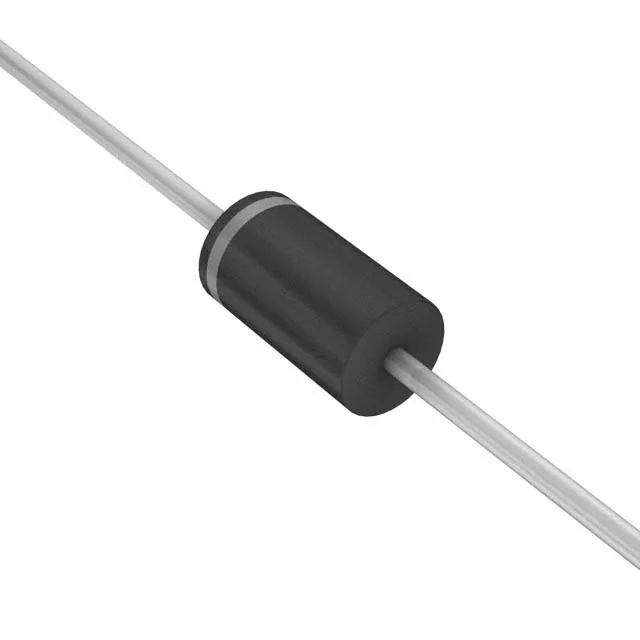
The 1.5KE20C-/73 comes in a DO-201AA (DO-27) axial-lead package, through-hole mount. The axial leads are rated for the full 51.5 A peak pulse current — the lead cross-section and solder joint are the current path, not the plastic body. The Tape & Box (TB) packaging is a bulk handling format, not a reel; plan for manual or tube-fed insertion rather than automated pick-and-place. The supplier device package code is simply '1.5KE', which is the standard Vishay footprint for this power level. The base product number is 1.5KE20, so the full ordering code 1.5KE20C-/73 includes the bidirectional suffix (C) and the packaging suffix (/73 for TB).
Obsolete — sourcing through independent channels
Vishay lists the 1.5KE20C-/73 as Obsolete. No official successor order code is recorded in the lifecycle data. This means the part is no longer manufactured and is not available through the standard Vishay distribution channel. The part is a standard 1.5 kW TransZorb® in the DO-201AA package, so a functional replacement from another manufacturer (e.g., Littelfuse, STMicroelectronics, or Diodes Inc.) is possible, but the pinout and footprint are not guaranteed to match without a board spin.