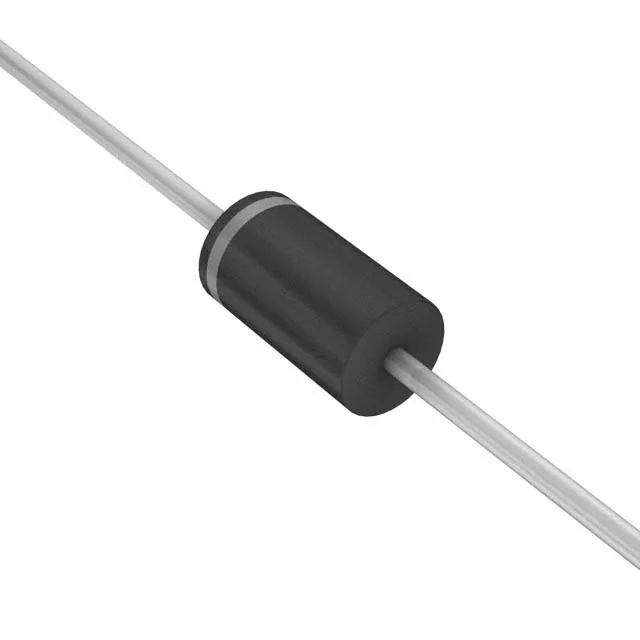
Obsolete TransZorb — what the ratings mean for your BOM
The 1.5KE18C-E3/54: The bidirectional channel means a single device clamps both positive and negative surges — useful on AC-coupled or bipolar signal lines where polarity isn't fixed. Vishay lists this part as Obsolete.
The DO-201AA (DO-27) axial-lead package is a through-hole form factor common to high-power TVS diodes. The 1.5KE body diameter is about 5.3 mm with 25.4 mm lead spacing — the leads are tin-plated copper and solder easily into standard 1.0 mm plated-through holes. No special thermal pad is needed; the junction-to-lead thermal path relies on the lead wire cross-section, so keep the trace width to the anode and cathode at least 2 mm wide to handle the 56.6 A peak current without trace lift. The 1500 W rating is derated above 25°C per the datasheet curve — at 175°C junction the peak pulse power drops to roughly 25% of the 25°C rating. For a 12 V rail in a 85°C ambient enclosure, budget the derating into the transient energy margin.
Sourcing an obsolete TVS — what to expect
Since Vishay has marked the 1.5KE18C-/54 as Obsolete, new-stock supply runs through independent surplus and broker channels. No last-time-buy window remains open from the factory. The reel packaging (Tape & Reel, TR) means the parts are on 13-inch reels — store them in a dry cabinet if the reel seal is broken; the axial leads are not moisture-sensitive, but long-term storage in high humidity can tarnish the tin plating. For a BOM that needs this exact clamp voltage and power level, the closest parametric match is another 1500 W bidirectional TVS with a 14.5 V standoff and 16.2 V minimum breakdown in the same DO-201AA package. No pin-compatible alternative is listed by Vishay as a direct successor, so the replacement must be qualified by the design team against the original clamping and peak current specs.