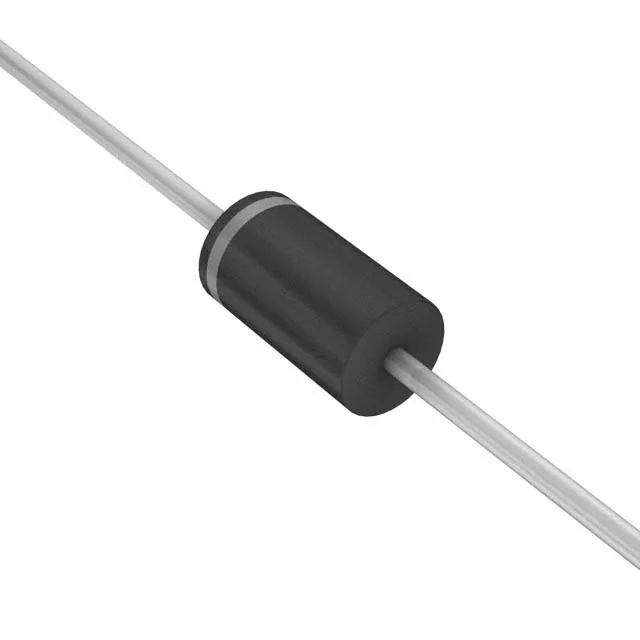
Automotive-grade surge clamp for 145V rails
The 1.5KE170CAHE3_A/C: It clamps transients at 234V maximum while conducting 6.4A peak pulse current, protecting a 145V reverse standoff rail — typical for 120VAC rectified buses or 144V battery systems in heavy-duty vehicles.
Clamping voltage and pulse current — what they mean for your BOM
For a 145V nominal bus, this clamp leaves a 89V margin above the operating rail — enough headroom for most 200V-rated downstream components to survive without avalanche breakdown. The 162V minimum breakdown voltage is the threshold where the device starts conducting. Below 162V the TVS is effectively an open circuit; above it, the Zener action shunts the surge current. This 17V window between standoff (145V) and breakdown (162V) ensures the TVS does not leak during normal operation while still catching transients early.
Package and mounting for through-hole assembly
Housed in a DO-201AA (DO-27) axial-lead package, this TVS is designed for through-hole mounting. The 1.5KE body is the standard 1.5kW footprint — leads are tin-plated copper, compatible with wave solder or hand-soldering. The axial form factor suits point-to-point wiring on terminal strips or PCB layouts where the device bridges a bus and ground plane. Tape and reel packaging is available for automated insertion, though the axial lead format typically requires a radial-to-axial conversion feeder on most pick-and-place lines. For manual or low-volume assembly, cut-tape or bulk options are common through distribution.