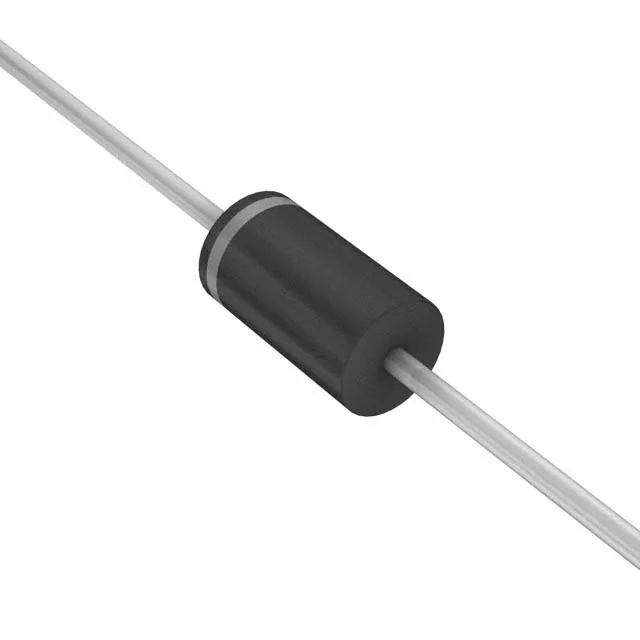
What the ratings mean for a repair bench
The 1.5KE160CAHE3/51: Its 136 V reverse standoff and 152 V minimum breakdown mean it clamps transients on a 120 V nominal rail — common in automotive 24 V systems or industrial DC buses that see load-dump spikes. When a surge hits, the diode clamps at 219 V max, shunting 6.8 A of peak current away from sensitive downstream electronics. The bidirectional channel handles both positive and negative transients, so polarity doesn't matter during installation — one less thing to check when you're swapping parts on a dead board.
No official successor is recorded from Vishay. For a pin-compatible replacement, look for a bidirectional TVS in the same DO-201AA (DO-27) axial package with a 136 V standoff and 1500 W rating — the 1.5KE series footprint is standard, so several manufacturers offer functional equivalents.
Automotive-grade transient protection
The through-hole DO-201AA axial package is easy to hand-solder or wave-solder into a PCB or terminal block — no special reflow profile needed. The bulk packaging suits low-volume repair or prototyping runs.