Obsolete TransZorb — sourcing reality for the 1.5KE13CHE3/54
This is a last-time-buy part; available stock moves through independent surplus channels, not the factory line.
AEC-Q101 qualification and the 175°C junction ceiling
Part of the Automotive, AEC-Q101, TransZorb series — the Q101 grade means it passed the full suite of automotive reliability screens: temperature cycling, HTRB, and preconditioning for the -55°C to 175°C operating junction range. A 175°C Tj max puts it beyond the 150°C ceiling of many general-purpose TVS parts — relevant for engine-bay or under-hood clamp circuits where ambient can hit 125°C and self-heating adds margin.
Breakdown and clamping — the surge protection envelope
Breakdown voltage min is 11.7 V; the part starts conducting above the 10.5 V standoff, clamping the transient at 19 V max. For a 12 V automotive battery line, this keeps the bus below the 36 V load-dump clamp threshold of downstream ECUs. The 78.9 A peak pulse current at the 10/1000 µs waveform is the survivable surge — a 1500 W TVS at this voltage level handles a direct lightning-induced transient on the battery line without failing short.
Through-hole axial DO-201AA — board integration
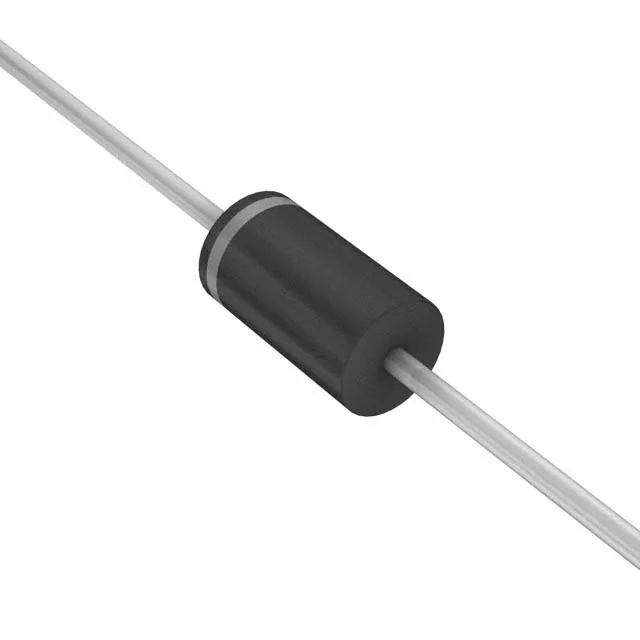
DO-201AA axial (DO-27 equivalent) — a through-hole package with 0.052-inch lead diameter. The body length is about 9.1 mm; the leads need a 1.2 mm hole diameter for wave-solder or hand-solder assembly. No power line protection feature — this is a unidirectional or bidirectional transient clamp, not a crowbar or foldback device. The bidirectional channel means a single part clamps both positive and negative surges.